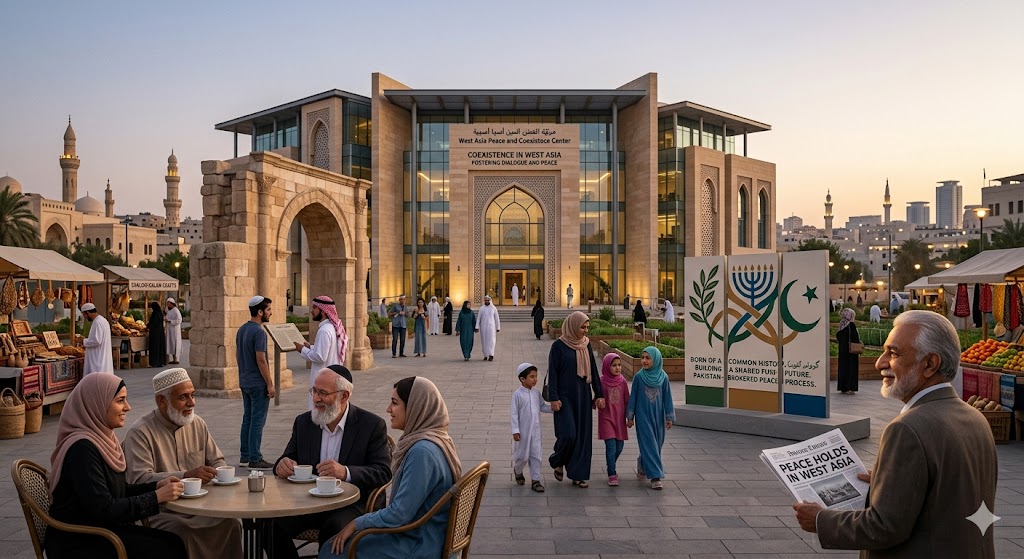
The recent U.S.–Israel–Iran war has reinforced a hard truth: military action may alter strategic calculations, but it rarely creates the conditions for lasting peace.
As the region grapples with the aftermath of the conflict, the need for meaningful Muslim–Jewish coexistence has become more urgent than ever. West Asia’s long-term stability will depend not only on ceasefires and diplomatic agreements, but also on rebuilding trust between communities whose histories, cultures, and futures remain deeply interconnected.
The war raised fears of a broader regional confrontation and deepened political and social divisions across the Middle East and among diaspora communities worldwide. In the wake of such crises, spikes in antisemitic incidents and anti-Muslim hostility are sadly common. Geopolitical conflicts too often spill over into everyday life, turning entire communities into targets for prejudice and suspicion.
Only extremists benefit from this dynamic. Everyone else pays the price.
— Ahmed Naeem KhanA History That Offers Hope
History, however, offers a more hopeful perspective. For centuries, Muslims and Jews lived alongside one another across the Middle East, North Africa, and parts of Europe. Jewish communities thrived in cities such as Baghdad, Cairo, Damascus, Fez, and Istanbul, making significant contributions to science, medicine, trade, literature, and philosophy.
There were, of course, periods of tension and conflict. But coexistence, cultural exchange, and mutual influence were often the norm rather than the exception. This shared history reminds us that hostility is not inevitable — and that peaceful coexistence is not an unrealistic ideal.
Even in recent years, examples of cooperation have emerged despite deep political disagreements. Interfaith initiatives, educational exchanges, humanitarian partnerships, and diplomatic engagement have demonstrated that dialogue remains possible during even the most difficult moments. These efforts are increasingly important at a time when misinformation on social media and extremist narratives seek to portray Muslims and Jews as permanent adversaries.
Pakistan’s Quiet Diplomacy — A Model for the Region
Amid the turmoil, Pakistan’s diplomacy stood out as an example of constructive engagement. Sharing a 900-kilometer border with Iran while maintaining close ties with both Tehran and Riyadh, Islamabad adopted a position of official neutrality while quietly keeping communication channels open with all sides.
🕊️ Pakistan’s Diplomatic Role at a Glance
Pakistan brokered the initial ceasefire, hosted the first round of talks, and — when negotiations teetered on collapse — dispatched senior officials to Tehran to keep dialogue alive. In a conflict defined by distrust and competing interests, Islamabad earned the confidence of both Washington and Tehran — a rare diplomatic achievement.
The key milestones in Pakistan’s peacemaking effort unfolded as follows:
-
Apr 8, 2026
Initial Two-Week Ceasefire Brokered — Pakistan secured the first pause in hostilities, creating space for diplomatic engagement.
-
Apr 10–11, 2026
Islamabad Talks — Round One — Pakistan hosted the first formal negotiation sessions. Foreign Minister Ishaq Dar traveled between regional capitals, coordinating with Saudi Arabia, Turkey, and Egypt.
-
May 2026
Critical Intervention — As the truce threatened to collapse, Interior Minister Mohsin Naqvi traveled to Tehran while Army Chief Field Marshal Asim Munir engaged directly with Iranian leadership to keep talks alive.
-
Jun 15, 2026
Peace Agreement Announced — Prime Minister Shehbaz Sharif announced that the United States and Iran, along with their respective allies, had reached a comprehensive agreement to end military operations across the region, including Lebanon. Qatar, Saudi Arabia, Turkey, and China were acknowledged as key supporters.
Patient, persistent, and often unglamorous diplomacy can accomplish what military escalation cannot.
— Ahmed Naeem KhanPakistan’s Role in Combating Antisemitism and Islamophobia
Pakistan is also well positioned to promote a distinction that is too often lost during regional crises: political disagreements must never be allowed to evolve into religious hostility.
Criticism of governments and state policies should never translate into hatred toward entire faith communities. By consistently advancing this principle, Pakistan can play a meaningful role in combating both antisemitism and Islamophobia while encouraging more balanced and constructive public discourse.
Its expanding diplomatic engagement with regional and international partners places the country in a unique position to support dialogue initiatives, interfaith outreach, and confidence-building measures. Pakistan alone cannot determine the outcome of regional disputes — but it can help create conditions in which peaceful solutions become more achievable.
A Shared Future — or a Shared Descent
The challenges facing West Asia — including economic uncertainty, climate pressures, displacement, extremism, and youth unemployment — cannot be resolved through military means alone. These problems affect Muslims, Jews, Christians, and others alike, creating a shared interest in stability, cooperation, and prosperity.
Lasting peace requires more than agreements signed by governments. It demands mutual respect among people.
The aftermath of the U.S.–Israel–Iran war presents the region with a choice. One path leads toward deeper polarization, rising intolerance, and recurring cycles of violence. The other points toward dialogue, coexistence, and collective problem-solving. Countries such as Pakistan, with their diplomatic reach and commitment to peaceful engagement, can help steer the region toward the latter.
Muslim–Jewish coexistence is more than a moral aspiration — it is a strategic necessity for a region seeking peace, security, and long-term prosperity. Rebuilding bridges between communities may prove to be one of the most important investments West Asia can make in its future.
— Ahmed Naeem Khan