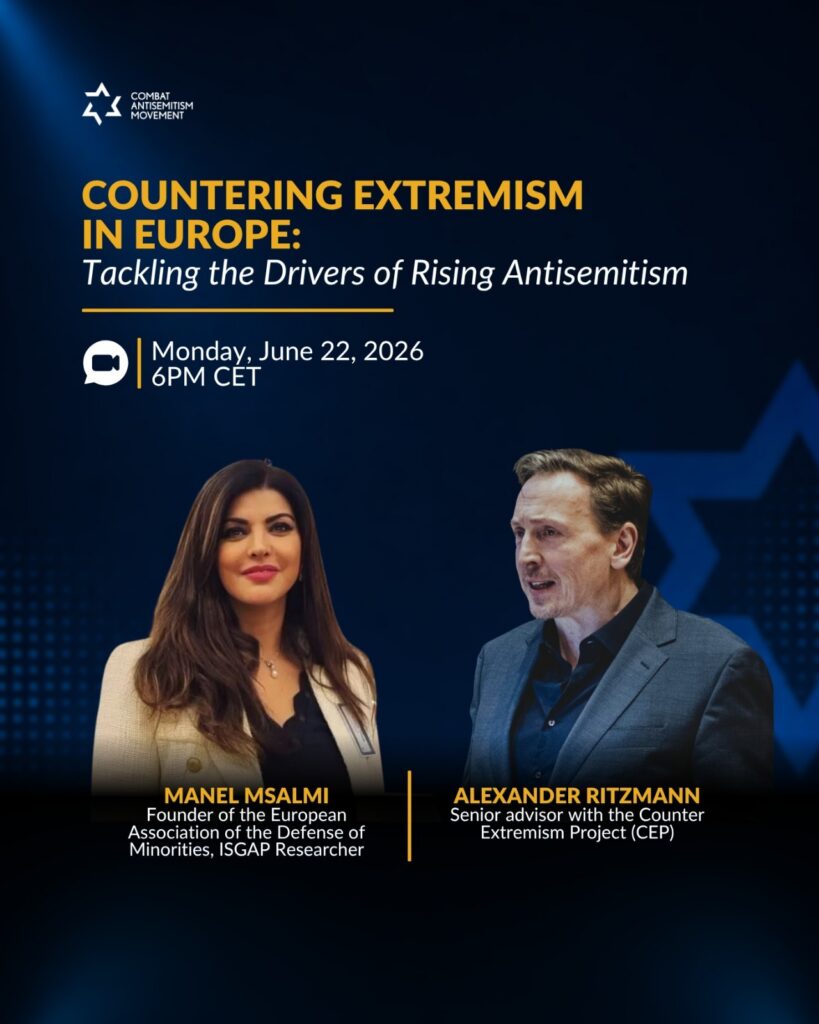
The Combat Antisemitism Movement (CAM) convened an urgent and wide-ranging webinar on the rise of extremism and antisemitism across Europe — bringing together two of the continent’s foremost experts to examine the ideological drivers of Jew-hatred, the role of organized professional antisemites, and the policy and educational tools needed to push back effectively.
The discussion, moderated by Shannon Seban, CAM’s Executive Director of European Affairs, offered a detailed look at data, case studies, and strategic frameworks that go beyond reactive law enforcement — calling instead for a proactive, intelligence-led approach to dismantling the networks behind organized antisemitic violence.
Manel Msalmi
Founder & President, European Association for the Defense of Minorities · Researcher, ISGAP
SpeakerAlexander Ritzmann
Senior Advisor, Counter Extremism Project (CEP) · Leading Expert on Radicalization & Security Threats
SpeakerShannon Seban
Executive Director, European Affairs — Combat Antisemitism Movement (CAM)
Moderator▶ Watch the Full Webinar
Hosted by the Combat Antisemitism Movement (CAM) · Open on YouTube ↗
Alarming New Data: 133 Incidents in One Week
Seban opened the webinar by presenting fresh data released that same morning by CAM’s own Antisemitism Research Center — confirming what Jewish communities across Europe have long been experiencing firsthand: antisemitism is not merely increasing in frequency, it is becoming normalized across political and social discourse.
🚨 Antisemitic Incidents Across Europe — One Week Snapshot
The remaining 11% is linked to far-right ideology. The data underscores that antisemitism is not the property of any single extremist movement — it spans the entire ideological spectrum.
From Incident Response to Strategic Disruption
Alexander Ritzmann of the Counter Extremism Project opened his presentation with a central insight: the conventional approach to antisemitism — treating each incident as an isolated hate crime — fundamentally misunderstands the threat. Antisemitism, he argued, has an organized professional infrastructure that operates much like a criminal network, with dedicated propagandists, logistics organizers, financiers, and enablers.
“We recommend moving from incident responses to strategic disruption of organized antisemitism. The goal is to give policy makers, law enforcement, and intelligence services tools to prioritize and disrupt the relatively small number of professional actors who enable large volumes of antisemitic mobilization and violence.”
— Alexander Ritzmann, Counter Extremism ProjectRitzmann drew on three research papers produced with the German Federal Foreign Office, including a five-step guide on identifying and disrupting key antisemitic actors. He cited Samidoun — a network designated or dissolved in multiple European countries and the US for its support of terrorism and ties to the Popular Front for the Liberation of Palestine — as a case study in organized, professional antisemitism.
The Four Categories of Organized Antisemites
Ritzmann proposed a framework distinguishing four types of professional actors within the organized antisemitism ecosystem:
📢 Professional Propagandists
Organize strategic communications online and offline; produce and amplify antisemitic messaging at scale.
🗂️ Professional Organizers & Fixers
Arrange logistics, venues, and coordination for demonstrations and events glorifying terrorism.
💰 Professional Financers & Enablers
Ensure the money flows to sustain operations, often with links to foreign state actors and organized crime.
🔗 Organized Crime Overlap
Some organized antisemites are also embedded in criminal networks — requiring a “follow the money” approach.
Key Policy Recommendation: Ritzmann called for the creation of a dedicated Violence-Oriented Antisemitic Extremism analytical category within intelligence and law enforcement — not a new criminal offense, but a framework to tag, prioritize, connect, and escalate cases across branches of government, enabling a more comprehensive picture of who is organizing antisemitic violence transnationally.
Antisemitism, Social Cohesion, and the Role of Education
Manel Msalmi — who has spent years advocating for women and minorities in conflict zones, particularly in the Middle East, North Africa, and South Asia — situated antisemitism within a broader crisis of social fragmentation in Europe.
“Any kind of discrimination is a sign of weakness in a society in terms of dialogue and cohesion,” Msalmi said. “When we exclude antisemitism from dialogue and ignore antisemitic incidents, we show fragility and a lack of empathy and solidarity between different ethnic and religious communities.”
“Targeting the Jewish community is also targeting every minority group. Today it is the Jewish community — but this is just the beginning. The rise of Islamism and its connection to the far left is targeting not only Jews but many other religious and ethnic groups.”
— Manel Msalmi, European Association for the Defense of MinoritiesMsalmi was particularly emphatic about the role of education as the cornerstone of prevention. She praised Holocaust education curricula in Germany and other European countries, endorsed Erasmus-style exchange programs that bring young people from Europe, the Middle East, North Africa, and Israel into direct dialogue, and called for stronger frameworks to bridge the gap between young people who — without interaction — default to prejudice.
Social Media: Algorithms as Accelerants
Both speakers addressed the profound danger posed by social media platforms whose engagement-based algorithms function as amplifiers of antisemitic content — regardless of intent. CAM’s own research revealed that TikTok had been generating AI-produced fake rabbis spreading antisemitic narratives, and that Instagram’s algorithm was routing users who followed health and wellness accounts toward antisemitic content.
“The platform really doesn’t care if somebody loves cute dog-and-cat videos or antisemitic content — they will get a lot of it. By design, these platforms are super spreaders. They can spread good educational content or extremist, terrorist, and antisemitic content. These companies are not our friends. They are here to make money.”
— Alexander RitzmannRitzmann acknowledged the EU’s Digital Services Act as a partial step forward, but argued that its implementation remains insufficient — comparing the expectation that platforms will self-regulate to asking Coca-Cola to solve the obesity crisis. His recommendation: focus enforcement resources on the organized professional antisemites who spend their days developing strategy and content — not on pursuing every individual who shares harmful material.
Transnational Networks: Muslim Brotherhood, Qatar, Iran, and Their Proxies
Closing the webinar, both experts addressed audience questions about the transnational infrastructure behind organized antisemitism — including the role of CAIR (Council on American-Islamic Relations), the Muslim Brotherhood, Qatar, and Iran and its proxies, including Hezbollah and the Houthis.
Ritzmann confirmed that CAIR “would fit into the framework” of groups warranting proactive investigation — not just for antisemitic activity but for compliance with regulations, tax obligations, government subsidies, and connections to foreign actors and terrorist networks.
“Not only the Muslim Brotherhood and Qatar but also Iran and its proxies — Hezbollah, the Houthis — they are interrelated, they are connected. Unfortunately, in the West, people are sometimes naive. The network is international. It has no borders. It attacks our democracy, our democratic values, and individual freedoms — not only in the West, but everywhere.”
— Manel MsalmiKey Takeaways
RIU Special Report
This is a special report by the Rooted in Unity editorial team. Source: Combat Antisemitism Movement (CAM) webinar. For more visit combatantisemitism.org. Rooted in Unity is a Houston, Texas–based initiative dedicated to dialogue, civic engagement, and principled advocacy across faith communities.