Throughout history, relations between Muslims and Jews have moved through periods of peaceful coexistence, intellectual cooperation, commercial partnership, and cultural exchange, as well as periods of conflict and mistrust. In today’s interconnected world, numerous Abrahamic, Muslim–Jewish, and interfaith organizations are working to strengthen dialogue, promote peace, encourage mutual respect, and reduce religious and political tensions.
These organizations operate across Africa, the Middle East, Europe, North America, and Asia. Their missions vary, but many share common objectives: fostering understanding among the followers of Judaism, Christianity, and Islam; promoting peaceful coexistence; defending human dignity; and encouraging collaborative solutions to global challenges.
Despite many successes, these organizations also face significant obstacles that can limit their effectiveness. Understanding both their positive contributions and their challenges is essential for strengthening future peacebuilding efforts.
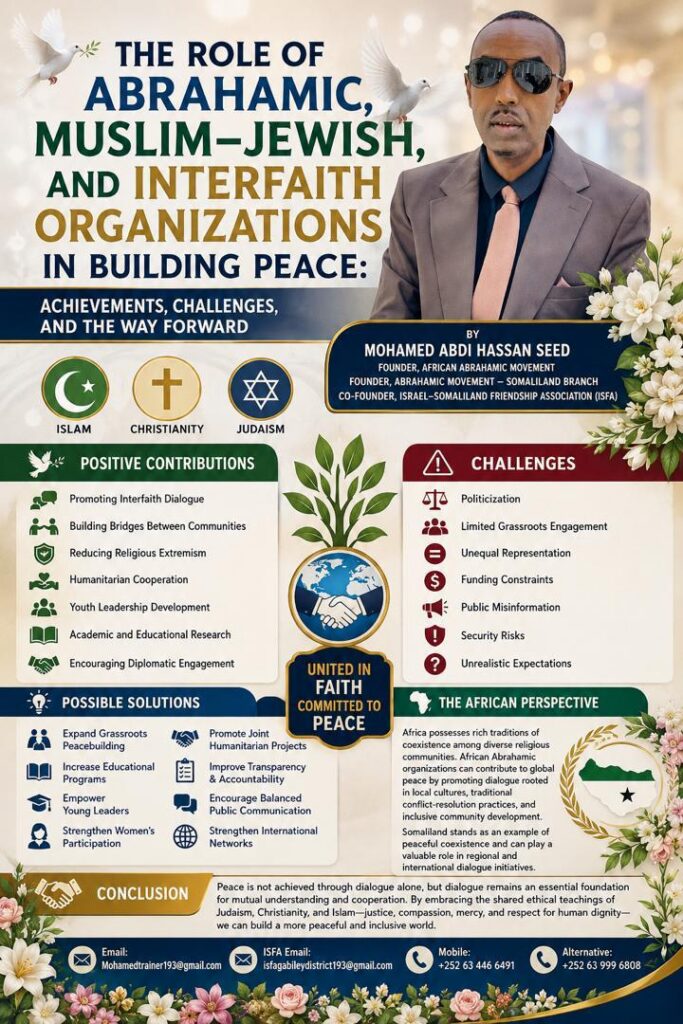
Positive Contributions of Abrahamic and Muslim–Jewish Organizations
Promoting Interfaith Dialogue
One of the greatest achievements of Abrahamic organizations is creating safe spaces where Muslims, Jews, and Christians can engage in respectful dialogue. Such dialogue helps participants challenge stereotypes, correct misinformation, build personal relationships, reduce prejudice, encourage empathy, and foster mutual respect. Personal interaction often transforms perceptions more effectively than political debates.
Building Bridges Between Communities
Many organizations organize interfaith conferences, youth exchange programs, educational workshops, peace forums, cultural festivals, religious study sessions, and community service initiatives. These activities strengthen trust between communities that may otherwise have little direct contact.
Reducing Religious Extremism
Extremist ideologies often thrive where ignorance and isolation exist. Interfaith organizations counter extremism by promoting accurate religious education, rejecting hate speech, encouraging critical thinking, supporting moderate religious voices, and demonstrating peaceful cooperation. These initiatives weaken narratives that portray other religious communities as enemies.
Humanitarian Cooperation
Many Abrahamic organizations work together during humanitarian crises, providing food assistance, medical care, refugee support, disaster relief, educational assistance, and community development projects. Humanitarian cooperation often demonstrates that compassion transcends religious differences.
Youth Leadership Development
Young people represent the future of peacebuilding. Many organizations provide leadership training, peace education, conflict resolution skills, international exchanges, community volunteering, and professional networking — equipping future leaders with the skills to build inclusive societies.
Academic and Educational Research
Many institutions support research on comparative religion, peacebuilding, history, human rights, and conflict resolution. Academic work contributes to evidence-based policymaking and informed public discourse.
Encouraging Diplomatic Engagement
Some organizations facilitate unofficial dialogue between civil society leaders, academics, religious figures, and policymakers. Such engagement can help reduce tensions and encourage practical cooperation even when official political negotiations are difficult.
Common Challenges and Negative Impacts
While many organizations make valuable contributions, challenges remain. Religious dialogue may become less effective when organizations are perceived as advancing political agendas rather than genuine reconciliation, making transparency essential to preserving credibility. Some organizations primarily engage political leaders, academics, or urban elites while reaching relatively few people at the community level, and successful dialogue depends on broad representation across religious traditions, age groups, women, youth, minority communities, and geographic regions.
Many organizations also depend on grants and donations, and financial uncertainty can limit long-term planning, staff development, regional expansion, and community outreach. False information circulating through traditional and social media can undermine years of trust-building, and organizations often struggle to respond quickly to misinformation. In regions experiencing conflict, peace activists and interfaith leaders may face public criticism, harassment, security threats, and social pressure, making the protection of participants essential. And dialogue alone cannot resolve every political conflict — peacebuilding should complement, not replace, diplomatic negotiations, legal frameworks, economic development, and community reconciliation.
Sustainable peace requires continuous engagement rather than one-time events, and personal relationships often create stronger foundations than formal declarations.
Lessons Learned
- Sustainable peace requires continuous engagement rather than one-time events.
- Personal relationships often create stronger foundations than formal declarations.
- Education is essential for overcoming prejudice.
- Youth involvement is critical for long-term success.
- Respectful listening is as important as speaking.
- Shared humanitarian work builds trust across religious boundaries.
Possible Solutions
Expand Grassroots Peacebuilding
Organizations should increase collaboration with schools, universities, mosques, synagogues, churches, community centers, women’s organizations, and youth groups. Local ownership strengthens peace initiatives.
Increase Educational Programs
Educational initiatives should include religious literacy, shared Abrahamic history, conflict resolution, human rights, civic responsibility, and ethical leadership to help reduce prejudice and misinformation.
Empower Young Leaders
Investing in youth through scholarships, leadership academies, exchange programs, entrepreneurship, and peace fellowships helps build a new generation committed to cooperation.
Strengthen Women’s Participation
Women play essential roles in families, education, healthcare, and community leadership. Greater inclusion of women in peace initiatives broadens perspectives and supports more sustainable outcomes.
Promote Joint Humanitarian Projects
Communities often build trust through shared action — medical outreach, clean water projects, environmental protection, food security, education, and disaster response reinforce shared values.
Improve Transparency and Accountability
Organizations should maintain clear governance, financial transparency, independent oversight, measurable outcomes, and regular public reporting to enhance public confidence.
Encourage Balanced Public Communication
Communication should avoid inflammatory language, promote factual information, respect diverse perspectives, condemn antisemitism, Islamophobia, and all forms of religious hatred, and highlight successful examples of cooperation.
Strengthen International Networks
Greater collaboration among organizations across Africa, the Middle East, Europe, Asia, and the Americas can facilitate the sharing of successful practices, educational resources, and peacebuilding expertise.
The African Perspective
Africa possesses rich traditions of coexistence among diverse religious communities. African Abrahamic organizations can contribute to global peace by promoting dialogue rooted in local cultures, traditional conflict-resolution practices, and inclusive community development. Countries such as the Republic of Somaliland, where different communities have long engaged in peaceful coexistence, may offer valuable experiences for regional and international dialogue initiatives.
Conclusion
Abrahamic, Muslim–Jewish, and interfaith organizations have made important contributions to promoting dialogue, reducing prejudice, supporting humanitarian cooperation, and encouraging peaceful coexistence. At the same time, they face challenges including political polarization, limited resources, misinformation, and security concerns.
Their long-term success depends on inclusive leadership, grassroots engagement, educational investment, transparency, and sustained collaboration across religious, cultural, and national boundaries. Peace is not achieved through dialogue alone, but dialogue remains an essential foundation for mutual understanding and cooperation.
By embracing the shared ethical teachings of Judaism, Christianity, and Islam — justice, compassion, mercy, and respect for human dignity — these organizations can continue to play a constructive role in building more peaceful and inclusive societies.