“It is good to have many enemies — it means you are influential and you stand in the right place to defend your ideas. Losers are not enemies to them.”
— Winston Churchill, as cited by Anthony SiefriedSomething extraordinary is happening. The World Abrahamic Movement — a global interfaith initiative built on the shared heritage of Islam, Judaism, and Christianity — is spreading with a speed and reach that has surprised even its own founders. Arab press, Turkish media, Iranian outlets, and Israeli newspapers are all covering it, each with their own angle: controversy, suspicion, curiosity, hope.
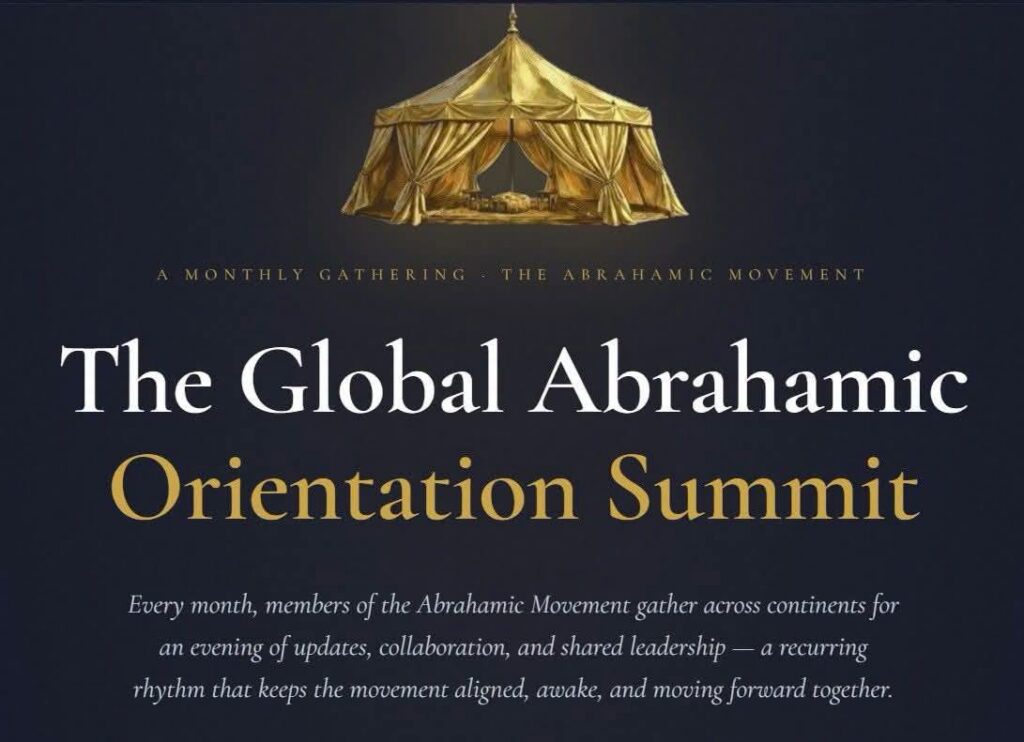
The reaction is itself a measure of impact. And now, to meet the flood of questions pouring in from activists, intellectuals, and ordinary people across the globe, the movement is calling its first ever Orientation Conference — a digital global summit via Zoom, open to all.
A Movement Generating International Press — and International Debate
Anthony Siefried, a contributor to the movement, describes the current moment with both pride and candor. The Global Abrahamic Movement is being talked about across the Arab world, in Turkey, in Iran, and in Israel — but the conversation is anything but uniform.
“The Arab, Turkish, Iranian and Israeli presses talk about it with great distinction of opinions — controversy and misconceptions, a fear of the unknown in some, and a great desire for freedom in others.”
— Anthony SiefriedThe range of reactions is itself revealing: where there is fear, it speaks to the movement’s challenge to entrenched narratives; where there is desire for freedom, it speaks to a hunger for something new. Both responses confirm that the Abrahamic Movement has touched a nerve — and that the questions it raises are ones people across the region are genuinely wrestling with.
The Questions People Are Asking
Daily, the movement is flooded with questions from people across political, religious, and economic contexts:
🤔 “What is the Abrahamic Movement?”
🌐 “What are you guys doing?”
🤝 “How can we belong to the Abrahamic community?”
With so many daily questions — political, religious, and economic — it is almost impossible to answer each one individually. The digital summit is the answer.
Who Will Be Speaking
The summit brings together four key voices from the movement’s global leadership:
Tom Wegner
The visionary founder driving the Global Abrahamic Movement’s rapid international expansion and strategic direction.
Soraya Deen
Founder of the Bureau of Muslim Speakers in the United States; a leading Muslim voice for interfaith engagement and civil advocacy.
Aviv Beilis Lerner
Overseeing the movement’s expansion across regions and the building of partnerships that translate Abrahamic values into tangible cooperation.
Majd Jbaily
The movement’s dedicated envoy to the Alawi community, deepening outreach and inclusion across the full spectrum of Abrahamic traditions.
What the Summit Will Cover
The orientation conference is designed to be a genuine two-way conversation — not a broadcast. Activists, faith leaders, curious observers, and skeptics are all invited to participate, ask questions, and engage directly with the movement’s leadership.
The session will address: What the World Abrahamic Movement is and what it stands for · How it is organized and how it operates globally · Why it is generating both enthusiasm and controversy across the Arab world, Turkey, Iran, and Israel · How individuals can join or engage with the Abrahamic community · Q&A open to all participants
Note: The full conversation will be in English. Anthony Siefried will subsequently summarize and publish an Arabic-language version for Arabic-speaking audiences across the region.
Why This Moment Matters
The World Abrahamic Movement is emerging at a moment of acute need. Across the Middle East, societies are navigating the aftermath of the U.S.–Israel–Iran conflict, deepening sectarian divisions, and a hunger — particularly among younger generations — for frameworks that go beyond geopolitical rivalry and religious exclusivism.
The Abrahamic tradition — the shared root of Islam, Judaism, and Christianity — offers exactly such a framework: one grounded not in political compromise but in the recognition that the children of Abraham share a common inheritance of faith, dignity, and moral purpose.
“There is a fear of the unknown in some — and a great desire for freedom in others. Both tell us this movement has touched something real.”
— Anthony SiefriedThat the movement is being discussed simultaneously in Arab, Turkish, Iranian, and Israeli media — with all the controversy, misconception, and genuine curiosity that entails — is itself a sign that the Abrahamic Movement has entered a space where change is possible. The first orientation conference is an invitation to be part of that conversation.