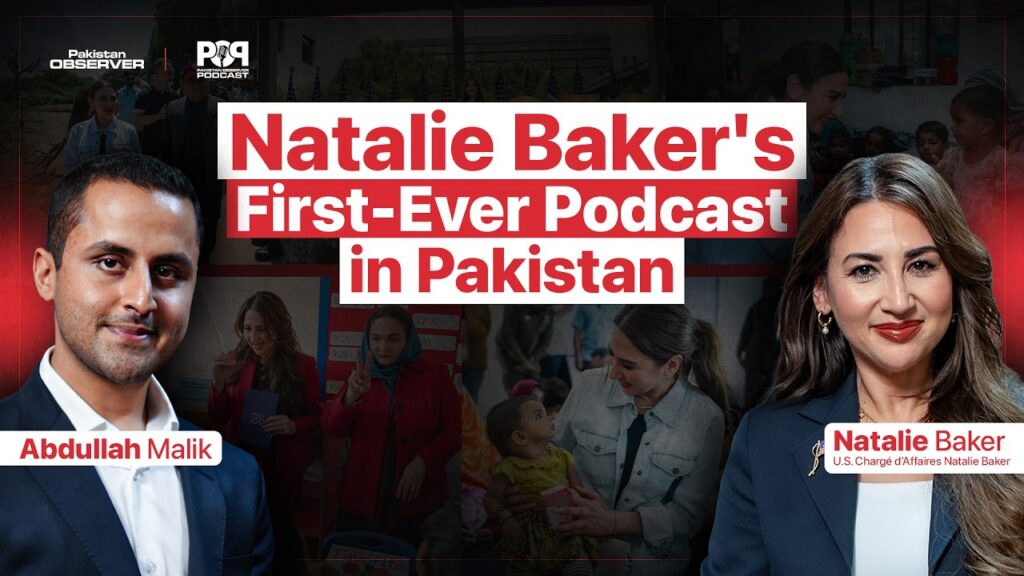
U.S. Chargé d’Affaires Natalie Baker made her debut podcast appearance on Pakistan Observer, sitting down for a wide-ranging conversation about the deepening ties between the United States and Pakistan — from cultural affinity and economic cooperation to Pakistan’s growing role as a regional mediator.
Cultural Affinity and a Warm Welcome
Baker, now in her second posting to Pakistan after also serving in the Middle East and the Gulf, spoke warmly of Pakistani hospitality and cuisine, singling out pakora with chai, bhindi, palak paneer, and fish and chicken dishes with rice as favorites. She said she’s often been mistaken for Pakistani and called it a genuine compliment, drawing a comparison to her home state of Texas, where, she said, no one is treated as a stranger.
A Historic High in Bilateral Relations
Baker described the US-Pakistan relationship as stronger than at any point in its history, with the two countries approaching 80 years of partnership. She pointed to aligned priorities around economic development, a landmark trade deal in progress, energy security, and critical minerals development, alongside long-running cooperation on counterterrorism, law enforcement, and military-to-military ties.
She highlighted Pakistan’s role in facilitating a recent U.S.-Iran memorandum of understanding as a milestone moment, noting that Pakistani leaders — including Field Marshal Asim Munir, the Deputy Prime Minister and Foreign Minister, and the Prime Minister — personally engaged in shuttle diplomacy between Washington and Tehran. She noted that Vice President Vance had described Munir as one of his most frequent contacts in recent months.
Key Themes From the Conversation
- Cultural affinity between Pakistan and the U.S., including comparisons to Texas
- America’s “Freedom 250” commemoration of 250 years since the Declaration of Independence
- Pakistan’s mediation role in the U.S.-Iran memorandum of understanding
- American companies operating in Pakistan, including Google, McDonald’s, KFC, Coca-Cola, and IBM
- Education exchange, including a roughly 45,000-strong Pakistan-U.S. alumni network
- Return of more than 450 cultural artifacts to Pakistan’s Islamabad Museum
- Investment in Pakistan’s youth, with an estimated 90 million children entering the workforce over the next decade
- Growing sports diplomacy, including cricket, football, and youth athletic exchange programs
Business, Education, and Cultural Exchange
Baker pointed to American companies operating in Pakistan — including Google, McDonald’s, KFC, Coca-Cola, Pepsi, IBM, and Cisco — as examples of investment paired with community impact, citing KFC’s partnership with the Deaf Reach School, which trains and employs deaf students, as a case she witnessed firsthand at a restaurant opening in Nowshera.
On education, she described Pakistan’s roughly 45,000-strong alumni network of Fulbright and exchange program participants as the largest in the world, supported by the U.S. Mission’s educational advising centers and a newly launched US Education Foundation building in Islamabad. She also discussed the recent return of more than 450 cultural artifacts to the Islamabad Museum, which she called a model for how nations can cooperate on cultural preservation.
Looking Ahead
Echoing a phrase she attributed to Prime Minister Shehbaz Sharif, Baker said simply: “the sky is the limit” for the future of the partnership.
Baker pointed to Pakistan’s young population — with a median age of 19 — as both a challenge and an opportunity, saying investment in education, technical training, and emerging fields like AI will be critical as an estimated 90 million children enter the workforce over the next decade. She also flagged sports diplomacy, including cricket, football, and youth athletic exchange programs, as a growing area of cooperation, and expressed hope for the eventual return of direct flights between the two countries to boost tourism and exchange.
Reflecting on resilience she witnessed during flood response efforts in Kasur, Punjab, Baker said the coordination between local agencies and communities left a lasting impression on her, and that Pakistani resilience continues to give her hope for the relationship’s future.
This article is based on Natalie Baker’s appearance on the Pakistan Observer podcast. Watch the full conversation above.