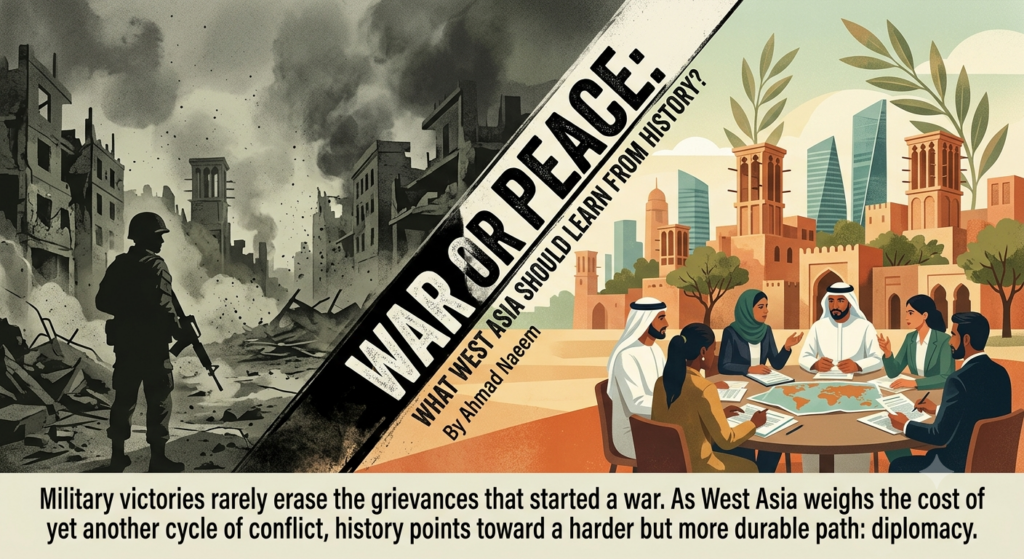
Throughout history, nations have gone to war believing that military force would resolve their disagreements, secure their interests, or establish lasting peace. Yet history repeatedly demonstrates that while wars may change borders, topple governments, or achieve short-term military objectives, they rarely eliminate the root causes of conflict. Instead, they create new grievances, deepen mistrust, devastate economies, and leave generations struggling with the consequences.
War inflicts immeasurable suffering. Millions of civilians have been killed, displaced, injured, or traumatized in conflicts around the world. Homes, schools, hospitals, and places of worship are destroyed, while families are separated and entire communities are uprooted. Children lose access to education and healthcare, and many carry the psychological scars of war throughout their lives.
Armed conflict diverts enormous financial resources away from education, healthcare, infrastructure, innovation, and economic development. Rebuilding cities and essential services often takes decades and costs billions of dollars. Businesses collapse, unemployment rises, investment declines, and poverty deepens. Even countries that achieve military victories frequently bear heavy economic burdens long after the fighting has ended.
Military victories seldom eliminate hostility. Instead, they often generate resentment, revenge, and cycles of retaliation. Communities that experience destruction, occupation, or displacement may carry memories of injustice for generations, making reconciliation increasingly difficult.
When political, territorial, ethnic, or religious grievances remain unresolved, violence tends to return in new forms. Sustainable peace requires addressing these underlying issues rather than relying solely on military force.
A Region Defined by Unresolved Disputes
Few regions illustrate the limitations of war more clearly than West Asia. For decades, the region has experienced repeated wars, occupations, proxy conflicts, and cycles of retaliation involving states and armed groups. Despite countless military campaigns, many of the region’s core disputes remain unresolved.
The long-standing Israeli–Palestinian conflict is one of the clearest examples. Repeated wars and military operations have resulted in immense human suffering, destruction of civilian infrastructure, and deep mistrust between Israelis and Palestinians. Yet the fundamental political issues — including security, mutual recognition, borders, and the future of the Palestinian people — remain unresolved. Lasting peace will require negotiations, security guarantees, and political compromise rather than military force alone.
Similarly, the recent escalation involving Israel and Iran demonstrated how quickly regional tensions can threaten wider instability. Although military actions may deter or weaken adversaries temporarily, they also increase the risk of broader regional conflict, economic disruption, and civilian suffering. Ultimately, durable stability depends on diplomacy, de-escalation, and sustained dialogue.
The wars in Syria and Yemen further underscore the devastating consequences of prolonged conflict. Years of fighting have displaced millions of people, devastated economies, damaged healthcare and education systems, and created some of the world’s worst humanitarian crises. Military campaigns have not produced comprehensive political settlements, highlighting the limitations of armed force in resolving deeply rooted disputes.
A Shared Global Cost
Today’s conflicts extend far beyond the battlefield. Wars disrupt global trade, increase food and energy prices, interrupt supply chains, fuel inflation, and generate refugee crises that affect neighboring countries and distant continents alike.
In an interconnected world, the consequences of conflict are shared globally, making peaceful dispute resolution an international interest rather than merely a regional concern.
Diplomacy Is the Only Way Out
Political and military leaders alike must recognize that negotiations remain the only sustainable way forward. Diplomacy requires patience, compromise, and political courage, but it offers solutions that violence cannot. Negotiation enables parties to understand each other’s concerns, identify common interests, and develop agreements that all sides can sustain.
Many of history’s most enduring peace agreements were achieved through dialogue, mediation, confidence-building measures, and international cooperation rather than military victory.
Organizations such as the United Nations and regional organizations provide mechanisms for peaceful dispute resolution through mediation, arbitration, peacekeeping, humanitarian assistance, and international law. Although these institutions face limitations, they remain essential alternatives to armed conflict.
Preventing war is not solely the responsibility of governments. Civil society, educators, journalists, religious leaders, and ordinary citizens all contribute to building peaceful societies by promoting dialogue, combating misinformation, rejecting hatred, and encouraging mutual understanding across political, ethnic, and religious divides.
The Choice Before Us
The experience of West Asia, along with countless conflicts throughout history, demonstrates that wars rarely resolve disputes permanently. Military action may achieve temporary tactical gains, but it often leaves behind destroyed communities, weakened economies, deep psychological trauma, and unresolved political grievances that fuel future violence.
Lasting peace is built through diplomacy, justice, dialogue, respect for human dignity, and the willingness to compromise. These approaches may be slower than military action, but they offer the only realistic path toward sustainable security and reconciliation.
In the twenty-first century, humanity possesses unprecedented technological, economic, and diplomatic tools. The challenge is not whether nations have the power to wage war, but whether they have the wisdom to choose peace. True strength lies in preventing conflicts, resolving disputes through dialogue, and creating a future where cooperation replaces confrontation.