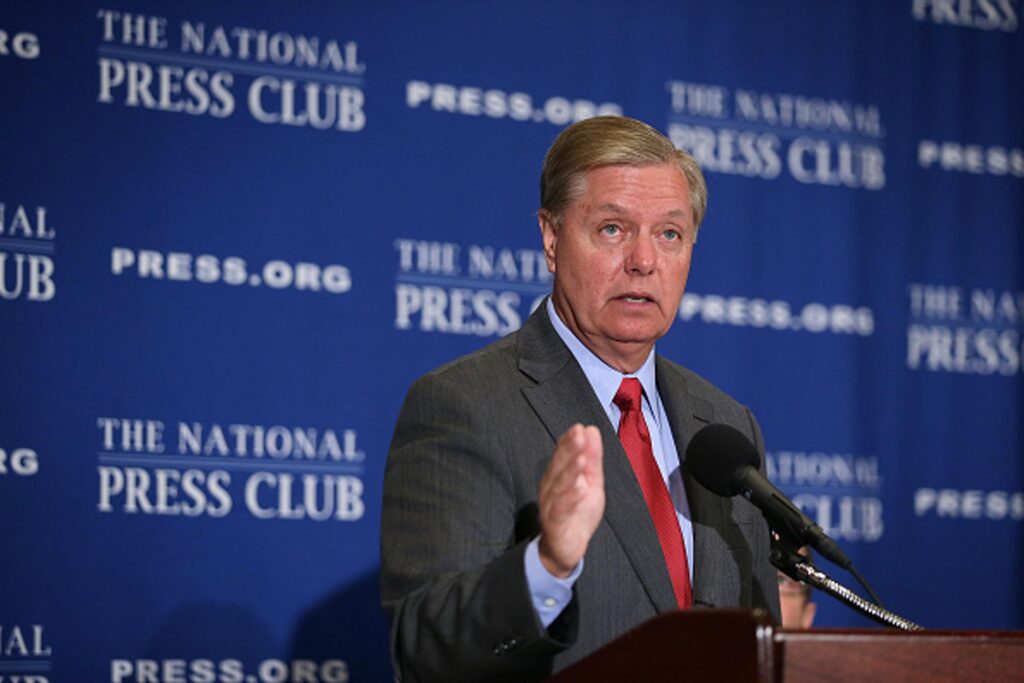
US Republican Senator Lindsey Graham said on Sunday that he expected normalisation between Israel and Saudi Arabia to happen this year — as long as Iran is put “in a box.” Appearing on CBS’s Face the Nation, Graham delivered a pointed message to both Riyadh and Jerusalem, urging them to seize a rare diplomatic opening that he believes is now within reach.
“I think this is going to happen 2026 and it can’t happen until Iran is in a box,” Graham said. “If we get a deal, Iran will be in a box. If we don’t get a deal, Iran will be in a box.”
🗝️ Key Points at a Glance
Trump as Dealmaker — Graham’s Message to Both Sides
Graham delivered a direct message to both Saudi Arabia and Israel: they had “no better friend” than US President Donald Trump, and the time to reopen negotiations on Riyadh joining the Abraham Accords was now. He reminded Israeli Prime Minister Benjamin Netanyahu that Trump had stood by him “when other people wouldn’t.”
“I’m not asking you to do anything to jeopardise the future of Israel’s security, but I am asking you to be open to expanding the Abraham Accords and finding a solution to Palestinians that are good for Israel, and quite frankly, good for the world.”
— Senator Lindsey Graham, to PM NetanyahuGraham’s comments come after rare public criticism of Israel by Trump in recent days. While the US President has warned Iran to stop its proxy group Hezbollah from “causing trouble,” he has also accused Israel of killing too many people in Lebanon — a notable tension in an otherwise close alliance.
Trump himself said in recent weeks that it “should be mandatory” that “all countries” sign on to the Abraham Accords after a deal is reached with Iran — framing normalisation as a non-negotiable outcome of the broader regional settlement now being negotiated.
October 2023: The Deal That Never Was
Graham recalled that plans had been in place to announce a framework agreement for Saudi Arabia to join the Abraham Accords at the end of October 2023 — but those plans were obliterated by the Hamas-led attack on Israel on October 7.
“That created a real problem. The Arab world is very upset about Gaza, and everybody in Israel is very upset about October 7, but we’re going to pick up where we left off,” Graham said — signalling that the diplomatic groundwork laid before October 7 remains the foundation for what could still be achieved.
Saudi Arabia has consistently stated that it will not normalise ties with Israel without a credible pathway toward an independent Palestinian state — a condition that continues to complicate, though not derail, the broader normalisation push.
The “Ultimate Win” — Accords as the Prize of War
Graham said last week on X that the “ultimate win” in the conflict with Iran would be to “open up a pathway to peace” through the expansion of the Abraham Accords.
“If the conflict with Iran yields this outcome, it will be one of the most successful military operations in American history.”
— Senator Lindsey Graham, on XHis framing is striking: a military conflict recast as a catalyst for regional peace architecture. It reflects a broader US strategic bet that containing Iran — whether through a nuclear deal or sustained military pressure — can unlock diplomatic breakthroughs across the Arab world that would otherwise be impossible.
Iran Peace Talks in Switzerland — and a Softened Graham
Graham’s comments come as US and Iranian negotiators meet in Switzerland to finalise a peace deal aimed at ending the war that began in late February 2026, when the US and Israel launched joint strikes against Iran.
Initially, Graham was a fierce critic of the proposed deal, warning that the proposed $300 billion reconstruction fund for Iran would “be akin to a Marshall Plan for Germany with the Nazis still in charge.” He has since moderated his position, saying he now expects Arab countries in the region to fund the reconstruction effort — a shift that signals growing Republican acceptance of a negotiated settlement.
Background: The US–Israel–Iran war began in late February 2026. Pakistan brokered an initial ceasefire on April 8, hosted the Islamabad Talks, and helped broker the June 15 peace framework — credited in part to Army Chief Field Marshal Asim Munir’s direct engagement with Iranian leadership at a critical moment.
What Normalisation Would Mean
A Saudi–Israel normalisation agreement would represent the most significant expansion of the Abraham Accords since the UAE, Bahrain, Sudan, and Morocco signed on in 2020. Given Saudi Arabia’s status as custodian of Islam’s holiest sites and its enormous geopolitical weight in the Arab world, its entry into the accords would fundamentally reshape the region’s diplomatic architecture.
For advocates of interfaith coexistence and Abrahamic unity, such a development would carry significance far beyond geopolitics — signalling that the world’s two largest Abrahamic faiths can share not just a neighborhood, but formal relations built on mutual recognition and cooperation.
RIU Special Report
This is a special report by the Rooted in Unity editorial team. Source: The National News. Rooted in Unity is a Houston, Texas–based initiative dedicated to dialogue, civic engagement, and principled advocacy across faith communities and national boundaries.