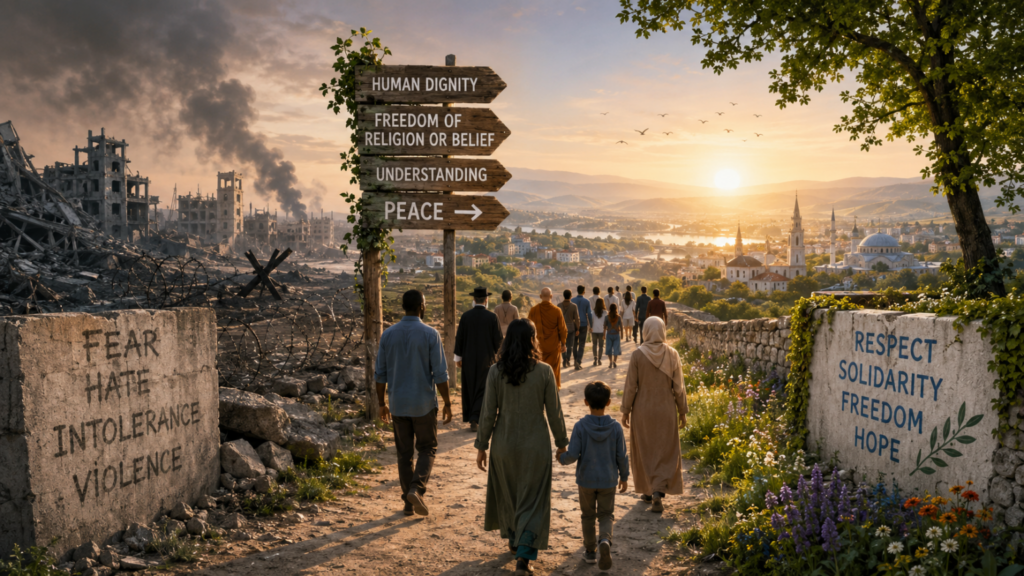
Armed conflict is among the strongest predictors of religious persecution. War increases government controls, heightens social tensions, fuels suspicion of minority communities, and creates conditions in which religious groups become convenient targets. In short, conflict often deepens the very conditions that undermine religious freedom.
As the United States and its allies engage in military action against Iran — with the peace MOU looking increasingly fragile — much of the world’s attention is focused on security, geopolitics, energy markets, and economic disruption. Yet there is another consequence that receives far less attention. Decades of research show that armed conflict nearly always makes religious freedom conditions worse.
For those concerned about freedom of religion or belief, this presents a sobering reality: even when military action is undertaken for legitimate security reasons, war frequently increases religious persecution, social hostilities, and government restrictions rather than reducing them.
Iran: Already Among the World’s Most Restrictive Countries
This concern is particularly relevant in Iran. According to Pew Research Center’s latest global study of restrictions on religion, Iran ranks among the world’s most restrictive major countries when both government restrictions and social hostilities involving religion are considered together.
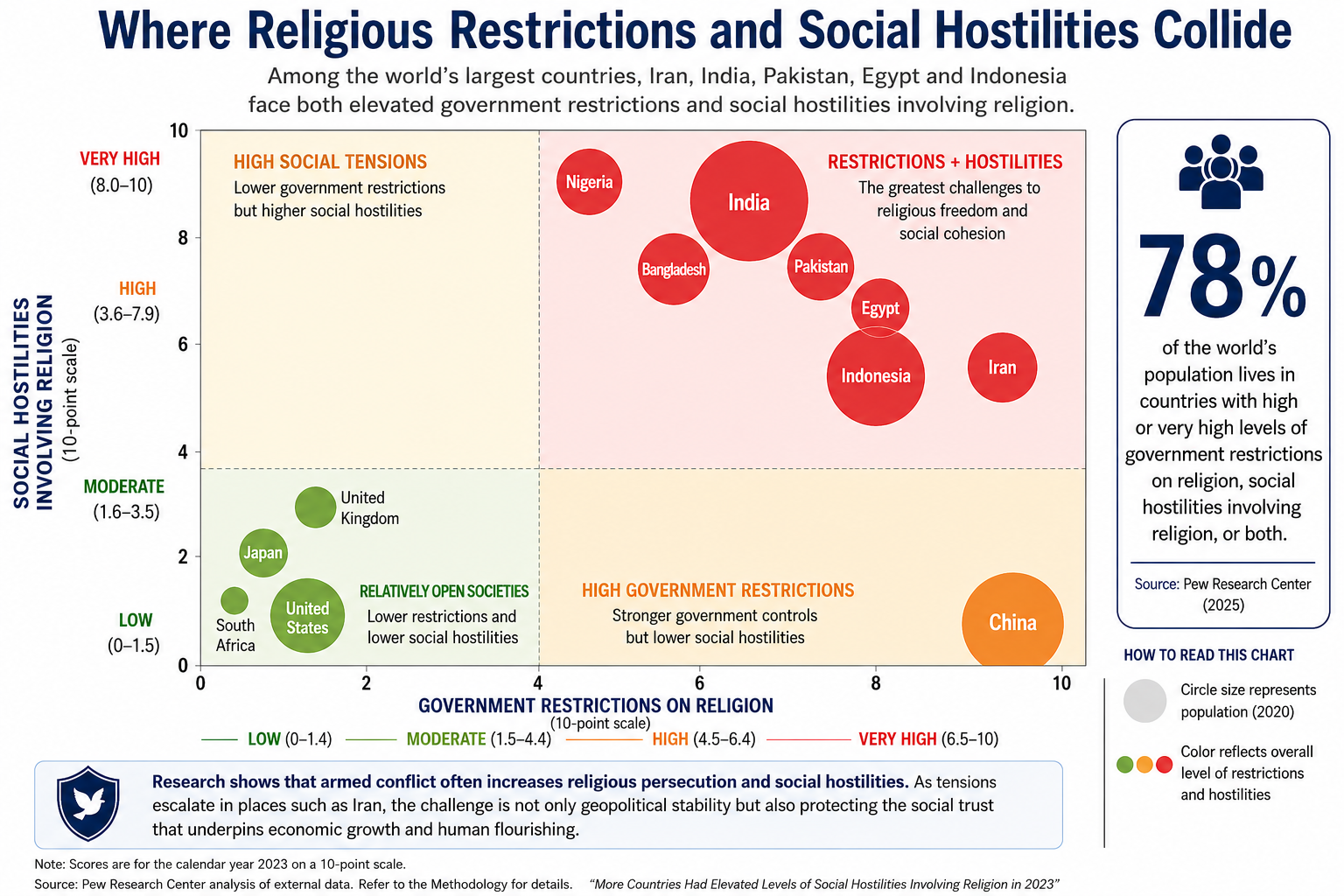
As the chart illustrates, Iran sits in the upper-right quadrant — reflecting both very high government restrictions on religion and high levels of social hostilities. India stands out as having both very high government restrictions and very high social hostilities, making it one of the most challenging environments for religious freedom among the world’s largest countries. Pakistan, Egypt, Bangladesh, Indonesia, Nigeria, and Iran also face significant levels of both. China occupies a different position — among the highest government restrictions globally, but with comparatively lower social hostilities. By contrast, the United States, United Kingdom, Japan, and South Africa remain in the lower-left quadrant, where both restrictions and hostilities are relatively low.
The Global Data: A Troubling Three-Year Trend
📊 Pew Research Center — Global Religious Restrictions 2023
New in 2023: Rising social hostilities are no longer confined to traditional conflict zones. Belgium, Norway, Spain, Sweden, and Russia all moved into the high-hostility category in 2023 — signaling that religion-related tensions are becoming increasingly relevant across developed economies.
War as an Accelerant — Not a Remedy
The relationship between conflict and religious freedom is not merely theoretical. Global research that Professor Roger Finke and Dr. Grim conducted found that armed conflict is among the strongest predictors of religious persecution. The mechanism is consistent across regions and eras:
War tends to increase government controls over religious life, heighten social tensions between communities, fuel suspicion of minority groups, and create environments in which religious communities become convenient scapegoats and targets. Conflict deepens the very conditions that undermine religious freedom — it does not resolve them.
“Even when military action is undertaken for legitimate security reasons, war frequently increases religious persecution, social hostilities, and government restrictions rather than reducing them.”
— Brian J. Grim, Ph.D., Religious Freedom & Business FoundationReligious Freedom Is an Economic Issue
For global business leaders, this is not merely a human rights concern. It is a strategic economic issue. Religious freedom and social cohesion are closely linked to trust — and trust is one of the most valuable forms of economic capital.
📉 When Freedom Erodes
Trust breaks down. Transaction costs rise. Talent becomes harder to attract. Teams fracture. Markets become harder to enter. Instability discourages investment.
📈 When Freedom Flourishes
Trust enables cooperation across difference. Institutions strengthen. Innovation accelerates. Entrepreneurship thrives. Long-term investment becomes possible.
🌍 Country-Level Impact
Countries with elevated religious restrictions tend to experience greater social conflict, political instability, corruption, and reduced investor confidence.
🏢 Business-Level Impact
Inclusive workplaces are not simply more just — they are more resilient, innovative, and prosperous. Diversity of belief drives better outcomes.
This is one reason why initiatives such as Dare to Overcome and the Religious Freedom & Business Foundation work to engage business leaders in advancing freedom of religion or belief as both a human dignity issue and an economic imperative.
About the Research — and the Researcher
Dr. Grim served as a senior researcher at Pew Research Center, where he led the development of the methodology now used globally to measure government restrictions and social hostilities involving religion. Over time, it became clear that while documenting the problem was essential, the global trajectory was still moving in the wrong direction.
That realization ultimately led him to found the Religious Freedom & Business Foundation — based on the conviction that making the economic and business case for religious freedom could complement traditional advocacy and engage new stakeholders who might otherwise remain on the sidelines of this global challenge.
A Challenge for Policymakers, Business, and Civil Society
As the conflict involving Iran unfolds, these lessons deserve careful consideration. Military outcomes may shape borders, security arrangements, and geopolitical alliances. But if history is any guide, conflict is also likely to affect religious freedom on the ground — and not for the better.
“The challenge is not only to seek peace. It is to build societies where people of all faiths and beliefs can contribute freely, fully, and peacefully. Human dignity, religious freedom, social trust, and economic prosperity rise or fall together.”
— Brian J. Grim, Ph.D.The lesson emerging from nearly two decades of global data is clear. Societies that protect freedom of religion or belief, respect human dignity, and create space for people of different faiths and convictions to contribute fully are better positioned to generate trust, economic opportunity, and human flourishing. Conversely, societies characterized by rising restrictions, increasing hostilities, and armed conflict often face growing instability and diminished prospects for long-term prosperity.

Brian J. Grim, Ph.D.
Brian J. Grim is the founder of the Religious Freedom & Business Foundation and a former senior researcher at Pew Research Center, where he developed the global methodology for measuring religious restrictions and social hostilities. Together with Professor Roger Finke, his research has established armed conflict as one of the strongest predictors of religious persecution worldwide.
View Full Profile →