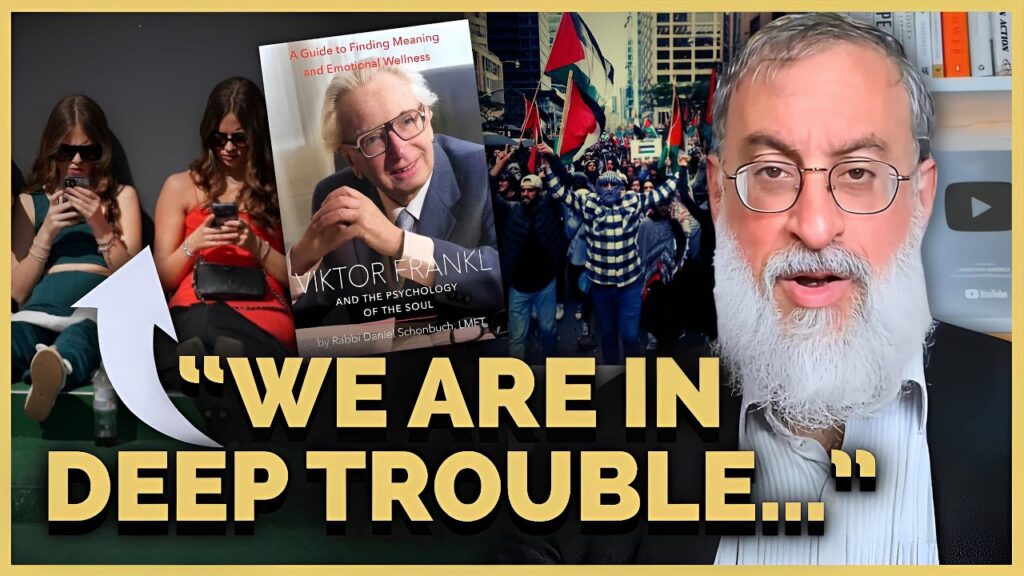
Former Gov. John Kasich interviews Rabbi Daniel Schonbuch, LMFT · Open on YouTube ↗
“The greatest challenge facing the United States of America right now — especially our youth — is the absence of meaning. What Viktor Frankl called meaninglessness.”
In a wide-ranging and deeply thoughtful conversation, Former Governor John Kasich sits down with Rabbi Daniel Schonbuch, LMFT — Brooklyn-based licensed marriage and family therapist, rabbi, author, and one of America’s leading experts in Viktor Frankl’s logotherapy — to explore the psychological and spiritual crisis gripping modern America, and the philosophy that may hold the key to reversing it.
Rabbi Schonbuch is the founder and owner of the Torah Psychology School of Coaching and Counseling and operates a private practice in Brooklyn treating serious cases of trauma, depression, anxiety, addiction, and relationship difficulties. He is also the author of Viktor Frankl and the Psychology of the Soul — a guide to meaning, resilience, and emotional wellness for an age of confusion, despair, and ideological extremism.
Frankl vs. Freud vs. Adler — Three Visions of What Drives Us
The conversation opens with a foundational question: what is it that human beings are ultimately searching for? Three towering figures of psychology give three very different answers.
Sigmund Freud
Profoundly secular, Freud reduced human beings to animal or mechanical impulses. He rejected God, the soul, and religious meaning — and became the dominant framework of Western psychology.
Alfred Adler
A disciple of Freud, Adler shifted the focus to power and the sense of inferiority — the drive to overcome powerlessness in society and to assert oneself in the world.
Viktor Frankl
Frankl disagreed with both. He argued that at the core of the human person lies not a drive for pleasure or power, but an irreducible search for meaning — the religio, a deep spiritual longing for God and purpose.
“If a person doesn’t find meaning, he’ll descend to power and to pleasure. And that’s where I see a lot of society going — looking for help towards pleasure and power rather than finding meaning.”
— Rabbi Daniel Schonbuch, LMFTAuschwitz Did Not Create Frankl’s Philosophy — It Confirmed It
One of the most striking revelations in the conversation concerns the origins of Frankl’s thinking. Many assume his time in the Nazi concentration camps — including Auschwitz — was where his philosophy of meaning was born. Rabbi Schonbuch corrects this: Frankl had developed his core ideas as early as the 1920s, when he was already corresponding with Freud as a teenager.
Frankl’s own words: When he arrived at Auschwitz, he said he was not discovering something new — he was experiencing what he had already written about. The camps were a litmus test, not a laboratory. The key insight they provided: even when stripped of all physical freedom, a person retains the ultimate freedom — the freedom to choose their own attitude toward suffering.
“Those who couldn’t find hope in suffering would lose their way — they’d run to the wire and take their own lives. Those who found meaning could endure. That is the most radical form of human freedom.”
— Rabbi Schonbuch, on Frankl’s insight from the campsThe Religio — A Dimension Freud Refused to See
At the heart of the discussion is Frankl’s concept of the religio — a dimension of the human person that goes deeper even than Freud’s id. Where Freud saw an impulsive drive for pleasure at the core of the psyche, Frankl saw something more fundamental: a spiritual longing, an inherent reach toward God and transcendence that is built into human nature itself.
Rabbi Schonbuch elaborates: Frankl believed that human beings are not simply three-dimensional physical creatures. He argued philosophically — and from a perspective that aligns with the Biblical account — that people are projected from a higher dimension, the world of noos (the Greek term for spirit or meaning). We carry within us something of that higher origin, and the soul’s longing to return to it is what drives the search for meaning.
“God did the first CPR in human history — He breathed a part of Himself into man. Viktor Frankl recognized that and asked: how do we arouse that religio in therapy? That’s the question Freud refused to even ask.”
— Rabbi Daniel SchonbuchLogotherapy Meets Traditional Psychotherapy — A Complementary Approach
Rabbi Schonbuch is clear on one point: logotherapy does not replace traditional psychotherapy — it completes it. He is trained in EMDR, somatic experiencing, and cognitive behavioral therapy, and uses all of them. But he argues that conventional therapy hits a ceiling — it can work through trauma and symptoms, but cannot address the deepest human need: the need for meaning, purpose, and spiritual connection.
What Traditional Therapy Does Well
Processes trauma through EMDR and somatic techniques. Reduces symptoms of depression and anxiety. Provides a safe, non-critical space for exploring feelings and belief systems.
What Logotherapy Adds
Reorients the person from the self outward — to values, to purpose, to community, to God. Addresses the meaninglessness that underlies addiction, depression, and suicidality. Provides tools the client can use every day between sessions.
The 30-Day Workbook
Rabbi Schonbuch’s book includes a 30-day meaningful life workbook: daily Viktor Frankl quotes, journaling on core values, and tracking meaningful experiences — shown to reduce depression and anxiety scores.
Faith as a Therapeutic Resource
For clients who seek it, Rabbi Schonbuch helps them access their own spiritual resources — prayer, community, relationship with God — as practical, clinically supported pathways to healing.
October 7, Campus Radicalization, and the Meaning Vacuum
One of the most striking moments in the conversation comes when Rabbi Schonbuch connects the crisis of meaninglessness directly to the wave of antisemitism and Hamas glorification that swept American college campuses after October 7, 2023.
“When October 7 happened — the worst attack against Jews since the Holocaust — I watched campuses flood with people supporting Hamas, glorifying murder. I asked: how is that possible? And I concluded: it’s because there has been such an absence of meaning for our children on campuses that murder could become glorified. Killers became the new heroes of society.”
— Rabbi Daniel SchonbuchFrankl’s framework explains it: when people cannot find meaning, they descend to power. And for a generation without moral anchors, religious foundations, or a sense of higher purpose, ideological violence can fill the void that meaning was supposed to occupy. This is not a political observation — it is a clinical one, grounded in decades of therapeutic experience.
The Secularization of the West — and Its Consequences
Both Kasich and Rabbi Schonbuch agree that the roots of the current crisis trace back roughly 150 years, to the systematic removal of God from public and intellectual life — what Rabbi Schonbuch calls “the domino effect of secularization.” Nietzsche’s declaration that “God is dead” initiated a cultural drift that has now, across several generations, produced its full harvest: skyrocketing addiction, depression, suicidal ideation, and — critically — the loss of the internal moral compass that natural law once provided.
Rabbi Schonbuch’s sobering observation: “If I would have one factor which would predict the fall of the West, it would be the removal of God from mainstream society. That’s why I believe it happened — 150 years ago. It just took time for the domino effect to play out.”
Silence, Solitude, and the Phone Fast
The conversation closes with a practical and urgent call: put down the phone. Rabbi Schonbuch, also a marriage counselor, describes the smartphone as the single greatest threat to the modern family — not because of content, but because of what it displaces: conversation, eye contact, shared meals, silence, and the internal reflection that gives rise to meaning.
His prescription: a daily phone fast — even one hour between 6 and 7 PM — to reclaim the silence and solitude that nourish the human soul. “The world will not fall apart in one hour,” he says. “Put away the phones. Listen to your spouse. Listen to your children. Your anxiety and depression levels will go down.”
Viktor Frankl and the Psychology of the Soul
Rabbi Daniel Schonbuch’s acclaimed guide to meaning, resilience, and emotional wellness in an age of confusion, despair, and ideological extremism. Includes a 30-day meaningful life workbook. Available on Amazon.
Get the Book on Amazon →
RIU Special Report
This is a special report by the Rooted in Unity editorial team. Rooted in Unity is a Houston, Texas–based initiative dedicated to dialogue, civic engagement, and principled advocacy across faith communities and national boundaries. Source: Rabbi Daniel Schonbuch’s YouTube channel.