New details have emerged about allegations that some United Nations human rights experts were pressured by colleagues not to publish evidence of sexual violence committed by Hamas against Israeli and Jewish women and girls, following a dramatic appeal by freed hostage Ilana Gritzewsky nearly 1,000 days after the October 7, 2023, attacks on Israel.
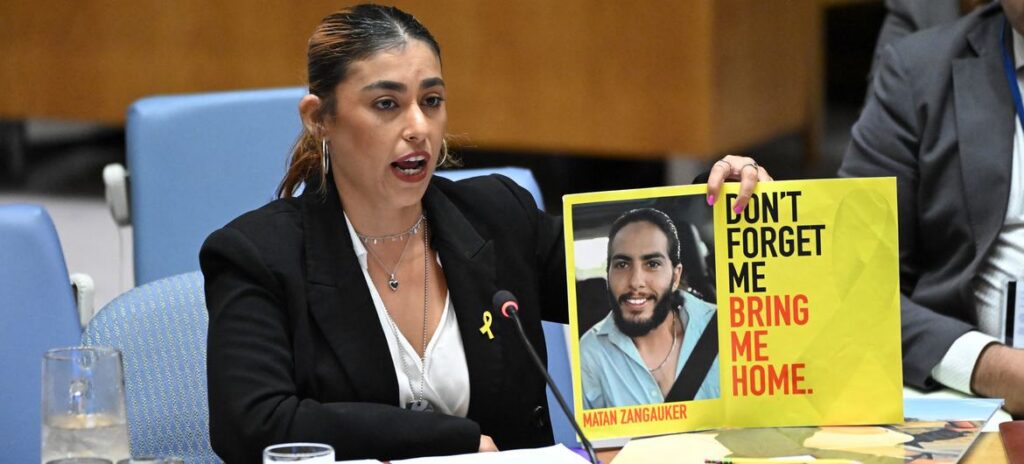
Appearing before the UN Human Rights Council in Geneva last week, Gritzewsky recounted being sexually abused, beaten, and mutilated after Hamas terrorists stormed her kibbutz during the October 7 attacks. She recalled regaining consciousness half-naked with seven terrorists standing over her, saying she did not know what had happened during the moments she had blacked out. Gritzewsky told delegates she returned from captivity with a broken hip, a broken jaw, and what she called “a scarred soul,” adding that the trauma continues to haunt her despite her release.
“Please look at me,” she pleaded, addressing UN Special Rapporteur on violence against women and girls Reem Alsalem, who has denied there is sufficient evidence that Hamas committed sexual violence during the October 7 attacks.
UN Findings
“Ms. Alsalem, you said there was no evidence of sexual violence on October 7,” Gritzewsky said. “I am the living proof of sexual violence by Hamas. When I and other Israeli women begged not to be raped, why were you silent?” She concluded by asking Alsalem, “Do you believe us now? Will you apologize?”
Video footage of the hearing appeared to show a lengthy silence afterward as Alsalem looked at Gritzewsky without responding or showing any visible emotion. Her testimony followed Alsalem’s public comments questioning reports that Hamas committed rape during the October 7 attacks. In social media posts, Alsalem wrote that no independent investigation had found rape occurred during the assault, and argued that allegations of Hamas sexual violence had been “weaponized” to justify what she described as genocide in Gaza.
Patten Report
However, a UN fact-finding mission led by Pramila Patten, the UN special representative on sexual violence in conflict, concluded after a 2024 mission that there were “reasonable grounds” to believe conflict-related sexual violence, including rape and gang rape, occurred at several locations during the Hamas-led attacks, including the Nova music festival, Road 232, and Kibbutz Re’im. The mission also cited “clear and convincing information” of ongoing sexual violence against hostages.
The controversy deepened after Alice Edwards, the UN special rapporteur on torture, disclosed that she faced internal pressure while documenting alleged Hamas atrocities. “There was a campaign to prevent that letter going out,” Edwards said in remarks reported by The Forward. Edwards said colleagues spent weeks trying to persuade her not to publish a January 2024 letter detailing allegations of torture, rape, gang rape, burning people alive, and other abuses committed during the Hamas-led assault, arguing the information was false. She added that the letter was significantly shortened after internal discussions, and that despite initial interest, only one fellow UN expert ultimately agreed to co-sign it because others were allegedly pressured not to do so.
“I am the living proof of sexual violence by Hamas. When I and other Israeli women begged not to be raped, why were you silent?” — Ilana Gritzewsky, freed hostage, addressing the UN Human Rights Council
New Evidence
The controversy resurfaced this week following Gritzewsky’s appeal, when Dr. Cochav Elkayam-Levy, chair of the Civil Commission on October 7 Crimes by Hamas Against Women and Children, presented what she described as the most comprehensive body of evidence to date documenting sexual violence committed during the October 7 attacks and against hostages held in Gaza. The commission’s 2026 report, titled “Silenced No More,” identifies 13 recurring patterns of abuse, including rape and gang rape, as well as accounts of women being sexually assaulted in front of relatives and hostages subjected to sexual abuse in captivity.
The findings were based on witness testimony, accounts from former hostages, and analysis of more than 10,000 photographs and videos, including footage recorded by the perpetrators themselves. Investigators also cited testimony and forensic evidence they said indicated some women and girls were sexually assaulted while being killed, while in other cases bodies showed signs of post-mortem sexual abuse.
Israeli investigators and the Association of Rape Crisis Centers in Israel have also published reports concluding that Hamas used sexual violence as a weapon of war. Hamas has denied the allegations, calling them baseless.
Accusations Against UN Experts
The strongest backlash has targeted Alsalem, who critics say has repeatedly downplayed the abuse — asserting that no Palestinian “cheered for rape in Gaza,” and emphasizing the UN Commission of Inquiry’s inability to independently verify certain allegations, citing alleged Israeli obstruction, while appearing to minimize broader patterns documented elsewhere.
Presenting her commission’s report at a UN side event organized by UN Watch, Dr. Elkayam-Levy accused the international community and UN mechanisms of abandoning Israeli victims: “I watched Israeli and Jewish victims receive neither the protection nor the solidarity that this system was created to provide. Many found themselves confronting a wave of hatred, denial, and dehumanization.” UN Watch and Israeli diplomats have repeatedly pointed to what they describe as a pattern of double standards — swift condemnation of alleged Israeli actions contrasted with hesitation or denial regarding Hamas crimes.
Broader Context and Reactions
- Some UN reports and experts have acknowledged “patterns indicative of sexual violence” by Palestinian forces but criticized Israel’s cooperation or drawn equivalence with unverified claims against Israeli forces.
- Israel has rejected certain UN inquiries as biased and accused the Human Rights Council of systemic anti-Israel prejudice.
- Advocacy groups including the Civil Commission stress that denial harms not only victims but the broader global fight against sexual violence in conflict.
- Patten’s team reportedly faced internal UN controversy for even conducting its mission, underscoring institutional reluctance in some quarters.
Dutch Concerns
Israeli officials have long accused parts of the UN human rights system of applying a double standard toward Israel and failing to adequately acknowledge the suffering of Israeli victims. The UN office supporting the independent rapporteurs said participation in joint communications remains at the discretion of each expert and did not directly address Edwards’ allegations of internal pressure.
The controversy has also resonated in the Netherlands, where former leading criminal lawyer and commentator Bram Moszkowicz, whose father survived the Auschwitz-Birkenau death camp, has warned that public debate about Israel has become increasingly polarized since the October 7 attacks. Speaking with the Dutch Christian organization Christenen voor Israël (Christians for Israel), Moszkowicz said many Dutch Jews are increasingly reluctant to speak publicly because of growing antisemitism, which he linked in part to what he called selective media coverage of Israel. He also criticized Dutch government plans to ban imports of products from Judea and Samaria, internationally known as the West Bank, arguing the measure would primarily hurt Palestinians employed by Israeli companies rather than the Israeli government. “If it goes on like this,” Moszkowicz said of the climate facing Dutch Jews, “I fear the worst.” The European Jewish Association says about 40,000 Jews have left Europe in recent years, including from the Netherlands, citing mounting antisemitism and growing insecurity.
Calls for Accountability
Survivors, Israeli officials, and independent experts are calling for full, impartial investigations without political preconditions; recognition of the October 7 sexual atrocities as potential crimes against humanity; reform or removal of rapporteurs perceived as biased; and greater focus on hostage suffering and justice for victims.
As Dr. Elkayam-Levy put it, the evidence is overwhelming: “Their bodies became a spectacle of war — and they received neither compassion nor protection.”
The controversy highlights ongoing debates over bias in UN human rights mechanisms, particularly regarding the Israel-Hamas conflict. While some UN bodies have documented aspects of the violence, critics say selective skepticism from key experts continues to retraumatize victims and erode trust in international justice. This story is developing, with further reports and testimonies expected to fuel calls for reform at the United Nations.
This report draws on testimony before the UN Human Rights Council, the Civil Commission on October 7 Crimes by Hamas Against Women and Children, UN fact-finding mission findings, and reporting by The Forward and Worthy News.