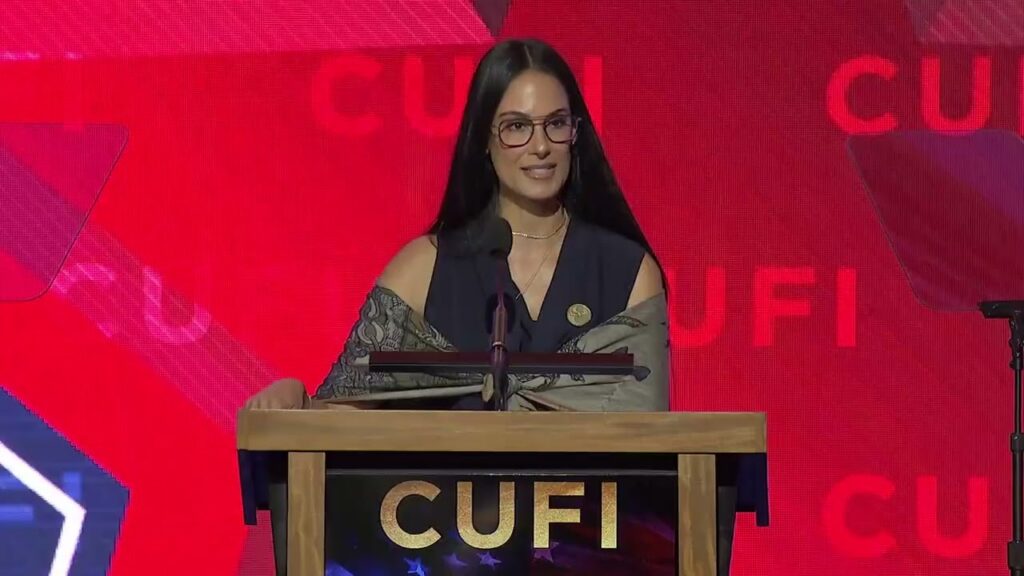
In a personal and forceful address, Dr. Sheila Nazarian — an Iranian-born Jewish physician, mother, and self-described proud American — recounted her family’s escape from Iran following the 1979 Islamic Revolution, using her own history as a warning about ideological alliances she says are re-emerging on American college campuses today.
Nazarian described how, in 1985, her mother took her and her sister to a bazaar where they were hidden in the back of a covered truck alongside strangers, driven toward the desert near the Pakistani border, and ultimately smuggled out under gunfire from border police. The family spent months in Pakistan and Vienna before legally entering the United States.
A Revolution Built on a Fragile Alliance
Nazarian traced the fall of the Shah of Iran to what she called an alliance that never should have made sense: Islamists who wanted religious rule joining forces with Marxists and secular leftists who claimed to champion women’s liberation and sexual freedom — two camps with almost nothing in common except a shared hostility toward Israel, America, and the existing government.
According to Nazarian, the Iranian left believed it was using the Islamist movement as a tool to bring down the Shah, assuming it would help lead the country afterward. Instead, she said, once the Islamists consolidated power they turned on their former allies — purging student activists, imprisoning professors and intellectuals, and shutting down universities that had helped fuel the uprising.
“The enemy of your enemy is not always your friend,” Nazarian said, describing it as the central lesson of the Iranian revolution.
Parallels on American Campuses
Nazarian argued that elite American universities today show echoes of that same dynamic, describing coalitions of socialists, Islamist sympathizers, pro-Palestinian activists, and feminist groups marching together despite what she characterized as conflicting underlying values — united, in her view, primarily by opposition to Israel, America, and capitalism. She said she sees this as historical illiteracy rather than genuine revolutionary consciousness, and pointed to what she described as foreign funding flowing into universities to shape student attitudes toward their own country.
She directed pointed questions at students who she said romanticize groups like Hamas or embrace socialist ideology, asking whether they understand the consequences such systems have historically had for women’s rights, LGBTQ+ people, and religious and ethnic minorities.
The Cost of Revolutionary Promises
Nazarian warned that revolutionary movements typically present themselves with promises of justice, equality, and free social programs — healthcare, education, housing — while obscuring the eventual costs. In her account, such promises are ultimately paid for through taxation, restricted personal choices, censorship, and expanding state control, a pattern she said has left Iranian women still fighting today for rights their grandmothers once had.
She also shared the story of a 17-year-old Jewish girl in Iran who, after being deceived into distributing pamphlets for a Marxist group, was imprisoned for five years and emerged with severe physical injuries — an account Nazarian said reflects the treatment of thousands of young Iranians who challenged the post-revolutionary government.
A Message on America and Israel
Nazarian framed America and Israel as nations built on shared principles — individual rights over state control, religious freedom, and the ability to question and change one’s government — arguing that hostility toward both countries stems from opposition to those very values. She cautioned that hatred directed at Jewish communities and at Israel often serves as an early warning sign of broader authoritarian sentiment.
She closed with a direct appeal against forming political alliances based solely on shared enemies rather than shared values, urging listeners not to trade freedom for the promise of free government benefits and not to assume that today’s revolutionary allies would remain trustworthy once in power.
This article is based on a video address by Dr. Sheila Nazarian.