AMMWEC Welcomes Saudi Educational Reforms Removing Antisemitic Content
AMMWEC Welcomes Saudi Educational Reforms Removing Antisemitic Content
A new curriculum review finds Saudi Arabia has scaled back hostile references to Israel and Jews — changes AMMWEC President Anila Ali has praised as a meaningful step away from religious exclusion.
Saudi Arabia has removed references to Palestine from some school textbook maps and dropped language describing Israel as the “Zionist enemy,” according to a new review of the kingdom’s textbooks. The changes come as efforts to revive the once fast-moving push toward Saudi-Israeli normalization gather pace.
The revisions, covering textbooks used between 2024 and 2026, also include the removal of a sentence declaring that Muslims will never give up Jerusalem, according to the Israeli-based curriculum monitoring organization IMPACT-se. The changes are significant because they strip away language long used to affirm the importance of Palestine and Jerusalem to Muslims, as Crown Prince Mohammed bin Salman continues a broader overhaul of the kingdom under his Vision 2030 program.
Key Curriculum Changes
IMPACT-se’s July 2026 review of textbooks for the 2024–25 and 2025–26 academic years found a continued trajectory of moderation in how Israel, Zionism, and related issues are presented.
What Changed
- Maps in social studies textbooks, including some grade 5 materials, no longer label territory within Israel’s internationally recognized borders as “Palestine” — in some cases the area is left unnamed, and Israel itself remains unidentified.
- A grade 11 history textbook that once referred to Israel as the “Zionist enemy” now uses the phrase “Israeli occupation” instead.
- A grade 11 Arabic-language exercise that included a line stating Muslims will never give up Jerusalem has been removed entirely from editions published from 2024–25 onward.
- Earlier reforms had already removed a textbook defining Zionism as a “racist” European movement and claims tying Zionists to the 1969 Al-Aqsa Mosque arson.
These adjustments build on earlier reforms. Previous IMPACT-se reviews had already noted the discontinuation of an entire high-school social studies textbook that defined Zionism as a “racist” European movement, along with the elimination of various antisemitic passages comparing Jews and Christians to “maimed animals” or asserting collective Jewish responsibility for historical events.
A Broader Pattern of Educational Reform
Saudi education authorities have been steadily reducing extremist, intolerant, and overtly hostile content for several years as part of Vision 2030’s social and economic modernization drive. IMPACT-se reports that the remaining examples of antisemitic material identified in earlier reviews have now been fully removed from the latest textbooks, while content promoting religious coexistence, critical thinking, and reduced hostility toward religious minorities has expanded.
Diplomatic Backdrop
The textbook revisions arrive against a backdrop of renewed diplomatic activity aimed at advancing Saudi-Israeli normalization. While full diplomatic relations have not been established, quiet contacts, shared strategic interests regarding Iran, and broader regional realignments have kept the possibility alive. Educational changes of this nature are widely viewed by analysts as confidence-building measures that help prepare domestic public opinion for closer ties.
Observers note that the gradual softening of language on Israel and Jerusalem represents a tangible shift from the more rejectionist framing that characterized Saudi curricula for decades. Whether these curricular adjustments accelerate formal normalization remains to be seen, but they form part of a consistent pattern of reform under the current leadership.
AMMWEC Welcomes the Changes
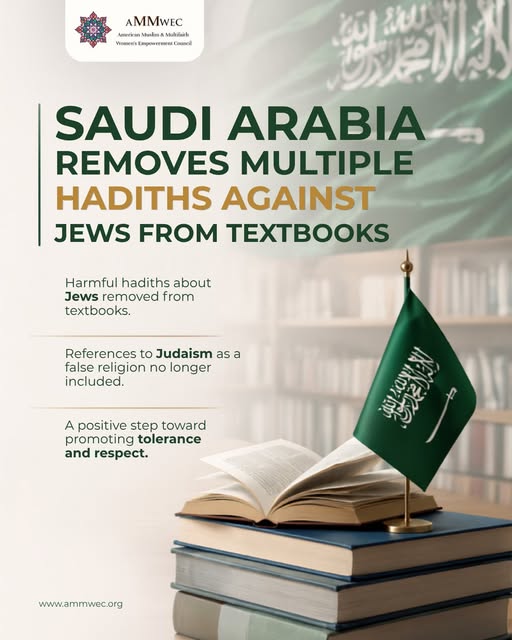
The American Muslim & Multifaith Women’s Empowerment Council, posting from Washington, D.C., said it was encouraged by related updates to Saudi educational curricula that it says have removed several hadith references involving Jews, Judaism, and other religions.
AMMWEC’s Statement
According to AMMWEC, among the removed material is a narration about the end of times that had been interpreted as describing Muslims fighting and killing Jews, which the organization says previously appeared in Saudi educational content but has now been taken out of the curriculum. The organization also points to a change in a Grade 7 Social Studies textbook, where a hadith that had been understood as implying Jews were destined for Hell is no longer included in the latest edition.
“These updates represent meaningful steps toward removing antisemitic and exclusionary interpretations from educational materials and promoting a more respectful understanding of different faith communities. Faith should never be a reason to hate. Together, we can choose peace over prejudice.” — Anila Ali, President, AMMWEC