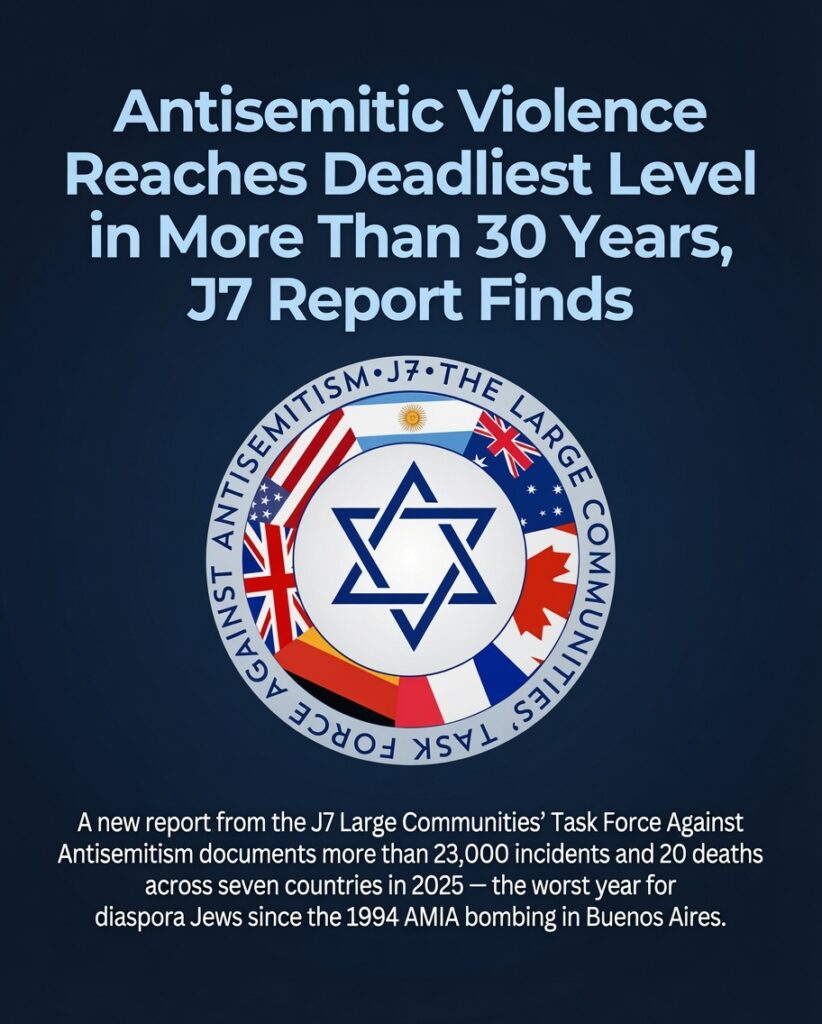

Antisemitic violence around the world reached its deadliest point in more than three decades during 2025, according to the second annual report from the J7 Large Communities’ Task Force Against Antisemitism. Twenty people were killed in targeted attacks last year — the highest annual death toll for Jewish communities outside Israel since the 1994 AMIA bombing in Buenos Aires — while researchers logged more than 23,000 antisemitic incidents across the seven countries that together are home to over 90 percent of the world’s diaspora Jewish population.
The report, released in late July 2026, covers Argentina, Australia, Canada, France, Germany, the United Kingdom, and the United States. It found that violent incidents in these nations climbed 97 percent since 2022 — the year before the Hamas-led attack on Israel on October 7, 2023 — while total reported incidents rose 136 percent over the same period. The task force’s researchers cautioned that anti-Jewish hostility is no longer limited to extremist fringes, describing it instead as increasingly embedded in universities, public demonstrations, online platforms, and daily life.
Antisemitism in our seven countries is no longer a surge; it is our new normal. J7 Large Communities’ Task Force Against Antisemitism, 2026 Report
Four Attacks, Twenty Lives Lost
The report attributes the 2025 death toll to four separate attacks carried out across three continents:
- Fifteen people were murdered during a Hanukkah celebration on Sydney’s Bondi Beach.
- Two people were killed in an attack outside the Heaton Park Synagogue in Manchester, England, on Yom Kippur.
- Two people were killed outside the Capital Jewish Museum in Washington, D.C., in May.
- One person died in a firebombing during a walk held in support of October 7 hostages in Boulder, Colorado, in June.
Taken together, these losses mark the deadliest year for Jewish communities outside Israel since the 1994 bombing of the AMIA Jewish community center in Buenos Aires, an attack that killed 85 people and has since been attributed to Hezbollah and Iran.
A Mixed but Elevated Picture Across Countries
Total incident counts eased from their 2024 peaks in several countries — falling 33 percent in the United States, 20 percent in Australia, 16 percent in Canada, and 16 percent in France. Elsewhere, the trend moved the other way, with incidents rising modestly in the United Kingdom, Argentina, and Germany. Even where numbers declined, every J7 country remained far above levels recorded before October 7, 2023.
Germany posted the highest totals both in absolute terms and per capita, logging 8,725 incidents, a rate the report describes as nearly 70 per 1,000 Jewish residents. Looking at the multi-year trend since 2021, Australia recorded the steepest rise of any J7 country, followed by Germany, the United States, and France. In the United States, 6,274 incidents were documented in 2025 — an average of roughly 17 per day — including approximately 300 physical assaults, even as the country’s overall total dropped from the year before.
Anti-Zionism as a Driver
The task force identified anti-Zionist sentiment as a significant motivating factor behind recorded incidents — cited in nearly half of cases documented in Britain and the United States, and in almost a quarter of those recorded in Germany. The report also devotes a chapter to antisemitism trends beyond the core J7 nations, including rising cases in Ireland.
A Coalition of Jewish Communal Organizations
Formed in 2023, the J7 Task Force brings together leading Jewish organizations from each member country, including the Anti-Defamation League and the Conference of Presidents of Major American Jewish Organizations in the United States, the Executive Council of Australian Jewry, the Board of Deputies of British Jews, CRIF in France, the Central Council of Jews in Germany, CIJA in Canada, and DAIA in Argentina. Its findings align with earlier academic analysis, including research from Tel Aviv University, suggesting that the surge in antisemitic incidents following October 7 has settled into a sustained, elevated baseline rather than a temporary spike.
Calls for Governments to Act Before, Not After
Jewish community leaders behind the report argue that the persistence of high incident levels, paired with a rising toll of lethal violence, calls for governments to move from reactive statements to sustained prevention. Their recommendations include increased security funding for Jewish institutions, stronger enforcement of hate-crime laws, clearer legal boundaries around antisemitic expression when it is framed as anti-Zionism, and greater accountability from social media platforms in enforcing their own content policies.
The report’s authors frame this as a turning point: antisemitism, they argue, has moved from the margins of society into mainstream civic, academic, and digital spaces, and reversing that trajectory will require coordinated action across governments, institutions, and online platforms alike.