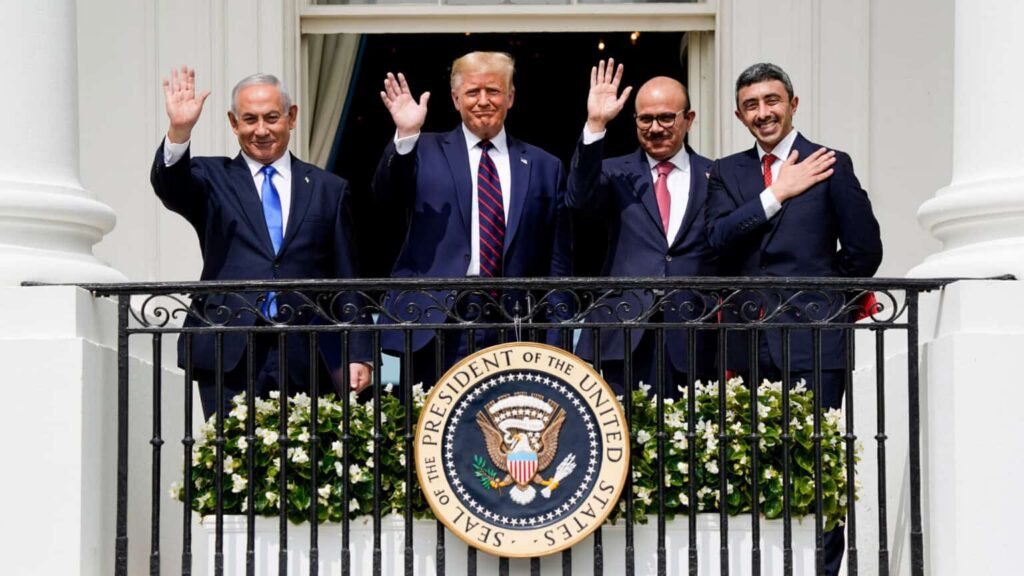
The Abraham Accords Enter a New Phase: Congress Looks Beyond the Middle East
Congress Moves to Widen Trump’s Abraham Accords — With Both Parties Signing On
Rep. Craig Goldman leads a 26-member bipartisan coalition seeking to extend the Abraham Accords framework into Central Asia and the South Caucasus.
A bipartisan bloc of House lawmakers this week introduced the Abraham Accords Expansion Act of 2026, a bill that builds on one of President Trump’s signature foreign-policy achievements and pushes it further outward. Rep. Craig Goldman (R-Texas), a co-chair of the House Abraham Accords Caucus, authored the legislation alongside every other co-chair of the caucus, drawing in more than twenty additional cosponsors from both parties.
The bill instructs the Special Presidential Envoy for the Abraham Accords to pursue new members in Central Asia and the South Caucasus — regions well beyond the Gulf states that first joined the framework. The original Accords, brokered during Trump’s first term, normalized relations between Israel and the United Arab Emirates, Bahrain, and Morocco. The circle widened again in 2025, when Kazakhstan signaled its intent to formally join.
“Through the Abraham Accords, America has expanded its influence across the world.” — Rep. Craig Goldman (R-Texas), co-author of the Abraham Accords Expansion Act
Goldman has argued that deeper coordination among Accords members does more than open new partnerships — it narrows the room for adversaries like Iran to operate, and that a more stable Middle East and Asia follow naturally from a longer roster of partner nations and a larger U.S. footprint in the region. Despite being a freshman member of Congress, Goldman has built outsized influence on the issue: a letter he circulated to House Republicans helped recruit thirty new caucus members, pushing total membership in the Abraham Accords Caucus to roughly a quarter of the House.
The Widening Accord
How membership in the framework has grown since 2020 — and where the new bill aims to take it next.
The bill drew quick praise from foreign-policy analysts. Tyler Stapleton, senior director of government relations at Foundation for Defense of Democracies Action, said the Abraham Accords have catalyzed a monumental shift in regional integration
across the Middle East, crediting the framework with shared economic gains, trade harmonization, and security cooperation between Israel and its neighbors. He said widening the pool of eligible nations — and creating a dedicated envoy to coordinate cooperation agreements — would extend those gains further, and confirmed his organization’s endorsement of the bill.
For an organization built on the conviction that bridges across difference make both nations and communities stronger, the Abraham Accords Expansion Act is a useful case study: a foreign-policy framework born of dialogue between former adversaries, now sustained at home by lawmakers who agree on little else. Rooted in Unity will continue following the bill as it moves through Congress.
Reporting drawn from Matthew Foldi’s exclusive for the Washington Reporter, with additional context from Rep. Craig Goldman’s post on X, June 16, 2026.