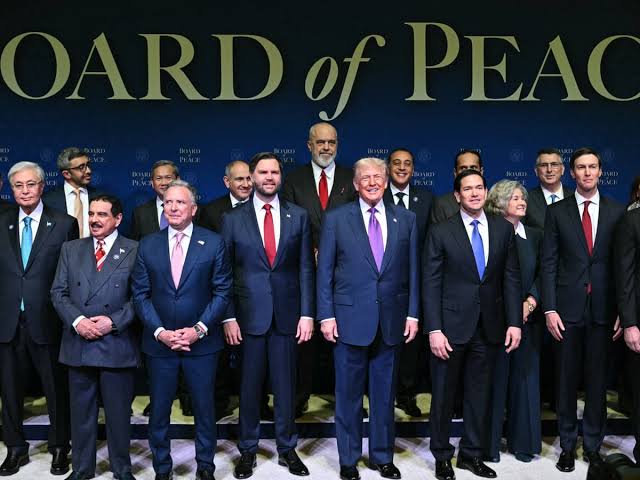
On Monday, the Trump-led Board of Peace insisted that the incoming Palestinian technocratic committee must control all weapons in Gaza, reacting to Hamas’s announcement that it had dissolved its territory-ruling body.
US President Donald Trump’s Board of Peace said Monday that the Palestinian technocratic committee tasked with governing Gaza must control all weapons, shortly after Hamas announced it had dissolved the body that ruled the territory.
“The core principle remains one authority, one law and one weapon. This means the consolidation of all weapons under the control of the NCAG (National Committee for the Administration of Gaza),” the Board said in a statement on X.
The NCAG, currently based in Cairo, was created by the Board of Peace, which Trump established when he brokered the Gaza ceasefire in October 2025. In a move widely viewed as a tactical ploy rather than a genuine relinquishment of power, Hamas announced on Monday that it has dissolved its de facto governing body in Gaza — the so-called Emergency Committee — paving the way for a handover of civil administration to the technocratic NCAG.
The announcement, delivered by Hamas Government Media Office head Ismail al-Thawabta, comes amid stalled implementation of the second phase of the U.S.-brokered ceasefire and reconstruction plan. It marks the first formal step by Hamas to exit day-to-day civilian governance after nearly 19 years of rule since its 2007 takeover of the Strip from the Palestinian Authority.
Yet the Board of Peace — the international body established under President Trump’s Comprehensive Gaza Peace Plan and endorsed by UN Security Council Resolution 2803 — made clear it will judge the development strictly by concrete deeds, not rhetoric.
“Our assessment will be guided by actions, not promises,” the Board stated, emphasizing the need for the NCAG to assume full, independent governing authority, including the consolidation of all weapons under technocratic control. The Board said it looks forward to advancing implementation mechanisms that deliver real services, reconstruction, and stability to Gaza’s population.
A Legacy of Failure and Terror
Hamas’s decision to step back from formal civilian administration arrives after years of mismanagement. Since seizing Gaza, the group built an extensive military infrastructure — including attack tunnels, rocket factories, and command centers embedded under hospitals, schools, and civilian neighborhoods — while the territory’s roughly 2.3 million residents endured poverty, unemployment, and repeated wars with Israel.
Critics say billions in international aid were diverted to weapons and to Hamas leaders living abroad in Qatar and Turkey. The October 7, 2023, attack — in which Hamas terrorists killed approximately 1,200 Israelis and took 251 hostages — is cited by the Board and Israeli officials as evidence of the group’s prioritization of its own objectives over Palestinian state-building.
Even after the ceasefire took effect in late 2025, Hamas has been slow to meet core obligations, particularly the disarmament of its military wing, the Izz ad-Din al-Qassam Brigades, and the dismantling of its broader military apparatus. Israeli officials have dismissed Monday’s announcement as “spin without any meaning” — a move they say is intended to avoid being declared in violation of the agreement while retaining de facto influence through its armed forces.
Israeli Foreign Minister Gideon Saar said that as long as Hamas keeps its weapons, any civilian government will operate under its dictates.
Technocrats vs. Theocrats: The Board’s Approach
The NCAG, headed by Palestinian engineer and former Palestinian Authority official Ali Shaath, is designed as an apolitical, professional body tasked with restoring essential services — health, utilities, education, and humanitarian coordination — and overseeing reconstruction under the Board of Peace’s strategic oversight.
The Board has laid out what it says progress requires:
- Full administrative handover without Hamas interference or veto
- Consolidation of all weapons and security functions under the NCAG’s unified authority
- A verifiable end to terror infrastructure, incitement in schools and media, and diversion of resources
- Cooperation that allows rapid delivery of aid and rebuilding for Gaza’s civilian population
Skepticism Warranted, But a Potential Opening
Hamas spokesman Hazem Qassem hailed the move as removing “pretexts for the occupation” and expressed readiness to hand over governmental responsibilities. But the absence of any commitment on disarmament or security control has fueled widespread doubt among diplomats and analysts. Palestinian factions in Cairo reportedly welcomed the development, yet experts note it leaves Hamas’s military wing intact and its influence over parts of Gaza society largely unchallenged.
The Board of Peace says it will continue to tie progress to concrete, verifiable steps — demilitarization, depoliticized governance, and reconstruction that benefits civilians — rather than accepting statements at face value.
For now, officials and observers describe Monday’s announcement as, at most, a tentative first step. Whether it marks the beginning of a genuine transition or another stalled chapter in Gaza’s post-ceasefire process will depend, the Board says, on actions rather than press releases in the weeks ahead.
This report draws on the Board of Peace’s public statement, comments from Israeli officials including Foreign Minister Gideon Saar, and reporting on the Gaza ceasefire and reconstruction process, including coverage from NBC News and the Atlantic Council.